Loading...
Registered monuments
1. Sadiki College
Discoveries
2. Medersa el Bachia
Discoveries
3. Tunis City Hall
Discoveries
4. Municipal Theatre
Discoveries
5. Tourbet el Bey
Discoveries
6. Kasbah Mosque (Almohad Mosque)
Mosques and zawiyas
7. El Ksar Mosque
Mosques and zawiyas
8. Zitouna Mosque
Mosques and zawiyas
9. Hammouda Pacha Mosque
Mosques and zawiyas
10. Sahib el Tabaa Mosque
Mosques and zawiyas
11. Sidi Mehrez Mosque
Mosques and zawiyas
12. Youssef Dey Mosque
Mosques and zawiyas
13. Sidi Kacem Jellizi
Mosques and zawiyas
14. Zaouia Sidi Ali Chiha
Mosques and zawiyas
15. Zaouia Sidi Brahim Riahi
Mosques and zawiyas
16. Zaouia Sidi Mehrez
Mosques and zawiyas
17. Club Tahar Haddad
Palaces and houses
18. Dar Bach Hamba – Cultural Centre for the Mediterranean
Palaces and houses
19. Dar Ben Achour
Palaces and houses
20. Dar Ben Ammar
Palaces and houses
21. Dar Bouderbala – Galerie Médina
Palaces and houses
22. Dar el Haddad
Palaces and houses
23. Dar el Jaziri
Palaces and houses
24. Dar el Jeld – Gastronomy and Tradition
Palaces and houses
25. Dar el Médina
Palaces and houses
26. Dar Hammouda Pacha
Palaces and houses
27. Dar Hussein
Palaces and houses
28. Dar Lasram
Palaces and houses
29. Dar Othman
Palaces and houses
30. Dar Rachidia
Palaces and houses
31. Diwan Dar el Jeld
Palaces and houses
32. El Ali
Palaces and houses
33. Hotel Tunisia Palace
Palaces and houses
34. Calligrapher
Souks and crafts
35. Flag makers
Souks and crafts
36. El Makhzen
Souks and crafts
37. Blacksmith
Souks and crafts
38. The bransi at work
Souks and crafts
39. Diwan Bookshop
Souks and crafts
40. Carpenter
Souks and crafts
41. Souk Chaouachine
Souks and crafts
42. Souk el Attarine
Souks and crafts
43. Souk el Berka
Souks and crafts
44. Souk el Blaghgia
Souks and crafts
45. Souk el Blat
Souks and crafts
46. Souk el Fekka
Souks and crafts
47. Souk en Nhas
Souks and crafts
48. Souk et Trouk
Souks and crafts
Souk et Trouk
Tunisia
History: the evolution of a souk The attachment of Ifriqiya to the Ottoman Empire (1574) brought an influx of Turks who differed in rite, language and also dress. To satisfy their tastes, new souks were founded in the early 17th century by Youssef Dey around his mosque: Souk el Bchemkia, Souk et…

360° virtual tour (3 scenes)

Location on the map

Souk et Trouk

History: the evolution of a souk

The attachment of Ifriqiya to the Ottoman Empire (1574) brought an influx of Turks who differed in rite, language and also dress.
To satisfy their tastes, new souks were founded in the early 17th century by Youssef Dey around his mosque: Souk el Bchemkia, Souk et Trouk…
The latter was reserved for tailor-embroiderers specialising in the garments of Turkish dress, the caftan being the main piece. But over the centuries the jebba supplanted the caftan, and the souk lost its function to others.

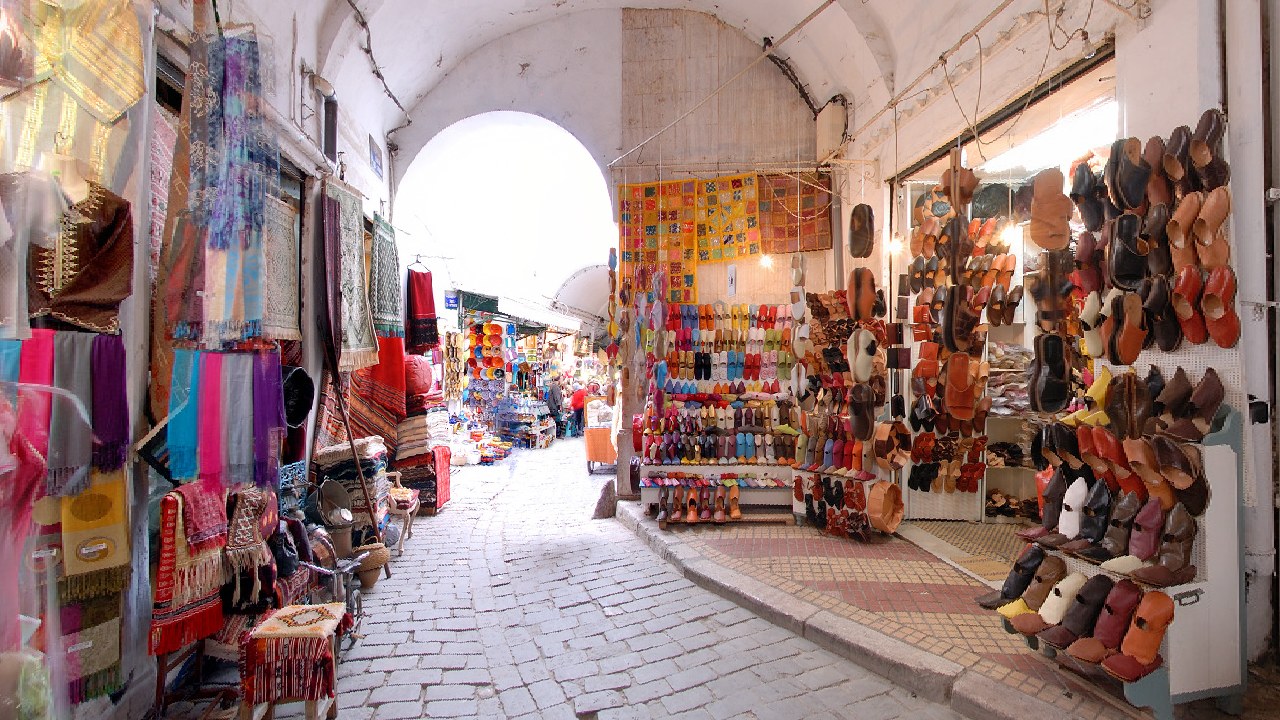
Its latest function is linked to tourism in Tunis. The row of small shops has given way to what has come to be called a "tourist bazaar". Three or four shops are combined into one large hall, with a terrace made accessible to give groups of tourists a panoramic view. The bazaar offers mint tea and a range of goods, from Kairouan carpets and Djerba jewellery to Nabeul pottery, leather, copper, glassware…

Some shops nevertheless stand out for their architectural setting with a heritage dimension, for the originality of their activity (antique dealers) or for an exclusive product (carpets in all their richness and regional variety).

A short story: guarding the souks

The way the souks are guarded has not changed for centuries.
At nightfall the craftsman closes his shop and the souks are entrusted to the guards, who close the souk gates.
Helped by dogs, they patrol the empty alleys and watch the roofs until the souk opens the next day. They are paid by the craftsmen and traders of the souk.