Registered monuments
1. Sadiki College
Discoveries
2. Medersa el Bachia
Discoveries
3. Tunis City Hall
Discoveries
4. Municipal Theatre
Discoveries
5. Tourbet el Bey
Discoveries
6. Kasbah Mosque (Almohad Mosque)
Mosques and zawiyas
7. El Ksar Mosque
Mosques and zawiyas
8. Zitouna Mosque
Mosques and zawiyas
9. Hammouda Pacha Mosque
Mosques and zawiyas
10. Sahib el Tabaa Mosque
Mosques and zawiyas
11. Sidi Mehrez Mosque
Mosques and zawiyas
12. Youssef Dey Mosque
Mosques and zawiyas
13. Sidi Kacem Jellizi
Mosques and zawiyas
14. Zaouia Sidi Ali Chiha
Mosques and zawiyas
15. Zaouia Sidi Brahim Riahi
Mosques and zawiyas
16. Zaouia Sidi Mehrez
Mosques and zawiyas
17. Club Tahar Haddad
Palaces and houses
18. Dar Bach Hamba – Cultural Centre for the Mediterranean
Palaces and houses
19. Dar Ben Achour
Palaces and houses
20. Dar Ben Ammar
Palaces and houses
21. Dar Bouderbala – Galerie Médina
Palaces and houses
22. Dar el Haddad
Palaces and houses
23. Dar el Jaziri
Palaces and houses
24. Dar el Jeld – Gastronomy and Tradition
Palaces and houses
25. Dar el Médina
Palaces and houses
26. Dar Hammouda Pacha
Palaces and houses
27. Dar Hussein
Palaces and houses
28. Dar Lasram
Palaces and houses
29. Dar Othman
Palaces and houses
30. Dar Rachidia
Palaces and houses
31. Diwan Dar el Jeld
Palaces and houses
32. El Ali
Palaces and houses
33. Hotel Tunisia Palace
Palaces and houses
34. Calligrapher
Souks and crafts
35. Flag makers
Souks and crafts
36. El Makhzen
Souks and crafts
37. Blacksmith
Souks and crafts
38. The bransi at work
Souks and crafts
39. Diwan Bookshop
Souks and crafts
40. Carpenter
Souks and crafts
41. Souk Chaouachine
Souks and crafts
42. Souk el Attarine
Souks and crafts
43. Souk el Berka
Souks and crafts
44. Souk el Blaghgia
Souks and crafts
45. Souk el Blat
Souks and crafts
46. Souk el Fekka
Souks and crafts
47. Souk en Nhas
Souks and crafts
48. Souk et Trouk
Souks and crafts
Tunisia
History: a milestone in the history of art in Tunisia The tradition of the funerary mosque, which combines the family tomb with the place of worship, was introduced by Youssef Dey and taken up by Hammouda Pacha barely forty years later. The construction of the mosque, dating from 1656-57, is…
360° virtual tour (9 scenes)
Location on the map
Hammouda Pacha Mosque
History: a milestone in the history of art in Tunisia
The tradition of the funerary mosque, which combines the family tomb with the place of worship, was introduced by Youssef Dey and taken up by Hammouda Pacha barely forty years later. The construction of the mosque, dating from 1656-57, is attributed to an Andalusian master builder named Nigrou.
The prayer hall is a very classical hypostyle hall, in which one can nevertheless see the two elements specific to Hanafi mosques: the masonry minbar (pulpit) and the sedda (central mezzanine).
In Maliki mosques the wooden minbar is mounted on rails and can be hidden in a recess after prayer. In the Hanafi mosque it is fixed and as carefully decorated as the mihrab, expressing the importance of the imam.
The sedda marks the privilege of the khouja, scholars who at specific moments of the prayer recite certain verses of the Qur'an in chorus while the faithful, in rows, sometimes listen and sometimes join in, in a well-ordered ceremony.
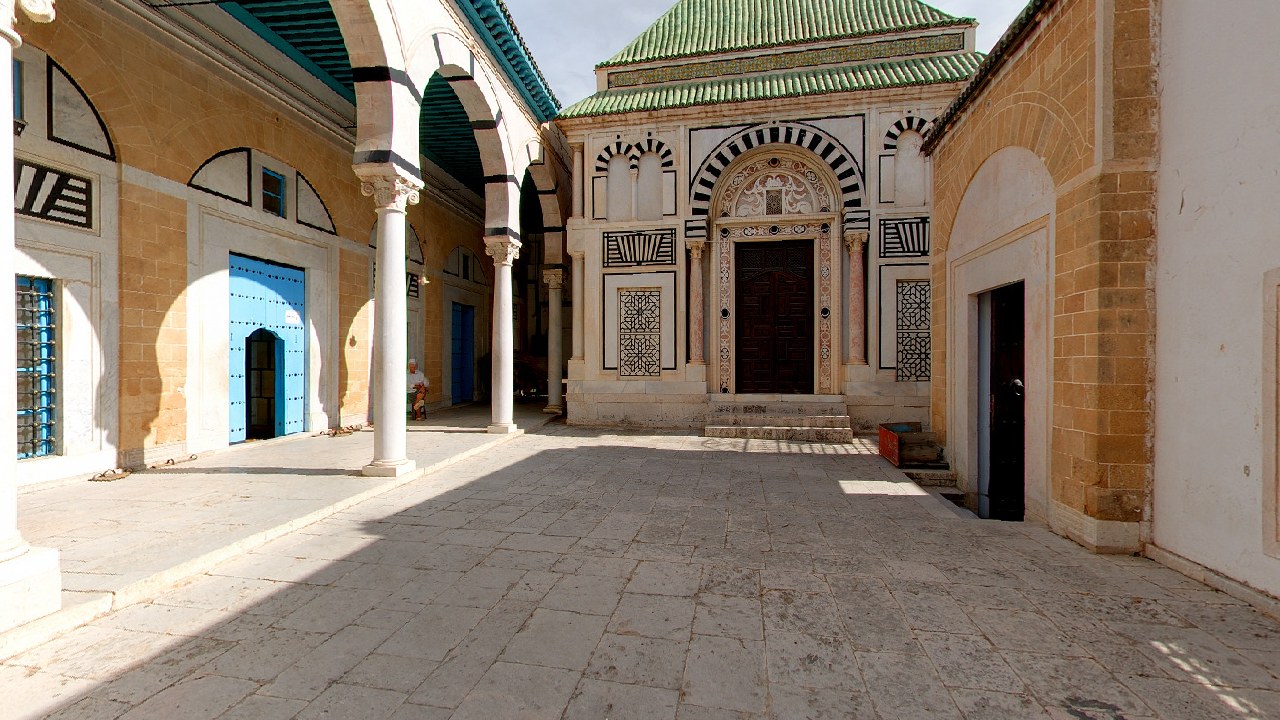
The minaret and the tourbet follow the architectural arrangement of those of the Youssef Dey Mosque. The Hammouda Pacha Mosque is nonetheless an important milestone in the history of art in Tunisia. It bears the mark of a new style of Italian influence grafted onto Hafsid and Andalusian traditions.
The use of black and white marble in courses or inlays finds fine expression on the main façade of the prayer hall and on the inner and outer façades of the tourbet. From the Andalusian style the tourbet borrows the composition of a superb carved and painted wooden ceiling and the arcaded stucco frieze. The novelty lies in the use of polychrome marble, which shines above all in the baroque decoration of the façades of the tourbet.
A short story: a dynasty founded by a renegade
17th-century Tunis was enriched by newcomers: Moriscos, Turks and renegades, also called "Turks by profession".
These were Europeans who converted to Islam to escape slavery and gain access to high office. They stood out for their energy, knowledge and technical skill, and held positions of trust: stewards of great Tunisian or Turkish families, advisers or secretaries to officials.
One of them, of Corsican origin, named Mourad, whose real name was Jacques Senty, was Bey of the camp in 1612. He was therefore responsible for collecting taxes in kind or in cash from the tribes during the tours held twice a year. A shrewd and intelligent man, he grew rich through privateering and, thanks to his generosity, won the esteem of the militia, the corsairs and the Sublime Porte. He obtained the title of Pacha and the right to pass on his office of Bey to his son and heir Mohamed, known as Hammouda.
Thus was born the Muradid dynasty, whose last representative was the bloodthirsty Mourad III, assassinated in 1702 together with all the Muradid descendants.
