360° virtual tour (3 scenes)
Location on the map
Souk Chaouachine
History: craftsmen from the upper bourgeoisie
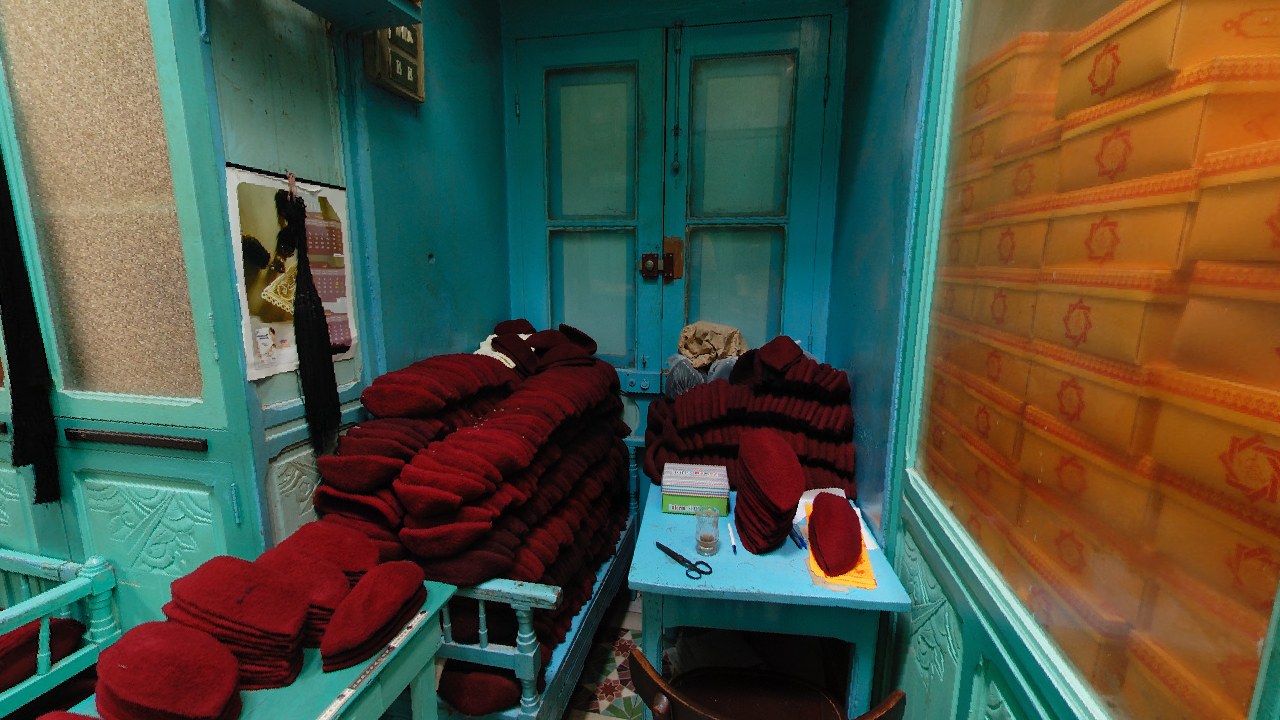
In his shop of carved woodwork, under the overhead light of a glass roof, the chaouachi puts the finishing touches to his chechias. But what a journey this red cap has made before taking its final shape!
Choice wool imported from Australia and Spain, washed, dried, carded and spun, reaches the knitters as skeins. They knit it on five needles to make the kabous, a loose cap about 30 cm in diameter and 40 cm deep. The kabous are sent to the fulling mill at El Battan, in the Medjerda valley, where they are felted with hot water and soap. They become a skullcap so tightly textured that the original stitches can no longer be seen. The cap returns to the souk in Tunis for carding and comes out soft and supple. It is then dyed in Zaghouan and comes back to the souk for further carding.
Finally the craftsman sews his mark inside with a design in black thread. The chechia is ready to continue its journey to the customer. It no longer supplies as wide a foreign market as in the past, but it is still exported to Algeria, Libya, Mali and Niger, besides the tourist market.
The rich shops of the chechia souk bear witness to the wealth of the chaouachi, who were recruited from the upper bourgeoisie of Tunis, often of Andalusian origin.
A short story: the tale of the old woman
This story was told to me by an old chaouachi about the crisis that hit the trade hard. "When the Andalusians," he said, "were preparing for the great departure, leaving everything behind, they took care to pack the tools they needed to carry on their ancestral craft in their new homeland. Just as they were leaving, an old lady stopped the convoy, went back home and returned with a small packet containing a few seeds of the special thistle used to card the chechia.
Settled in Tunis, the Andalusians explored the surroundings in search of the right soil and microclimate, and chose El Alia, near Bizerte, where the thistle was planted. The plantations flourished, the chaouachi of Tunis carried out their meticulous carding to perfection, and their trade prospered.
But then the lean years began. They remembered the old woman's story and lamented, saying: 'May God curse the old woman!' for without her they would have taken up another trade."
But did they bless the old woman when the chechia "made a rain of gold fall within the walls of Tunis"?
