Registered monuments
1. Sadiki College
Discoveries
2. Medersa el Bachia
Discoveries
3. Tunis City Hall
Discoveries
4. Municipal Theatre
Discoveries
5. Tourbet el Bey
Discoveries
6. Kasbah Mosque (Almohad Mosque)
Mosques and zawiyas
7. El Ksar Mosque
Mosques and zawiyas
8. Zitouna Mosque
Mosques and zawiyas
9. Hammouda Pacha Mosque
Mosques and zawiyas
10. Sahib el Tabaa Mosque
Mosques and zawiyas
11. Sidi Mehrez Mosque
Mosques and zawiyas
12. Youssef Dey Mosque
Mosques and zawiyas
13. Sidi Kacem Jellizi
Mosques and zawiyas
14. Zaouia Sidi Ali Chiha
Mosques and zawiyas
15. Zaouia Sidi Brahim Riahi
Mosques and zawiyas
16. Zaouia Sidi Mehrez
Mosques and zawiyas
17. Club Tahar Haddad
Palaces and houses
18. Dar Bach Hamba – Cultural Centre for the Mediterranean
Palaces and houses
19. Dar Ben Achour
Palaces and houses
20. Dar Ben Ammar
Palaces and houses
21. Dar Bouderbala – Galerie Médina
Palaces and houses
22. Dar el Haddad
Palaces and houses
23. Dar el Jaziri
Palaces and houses
24. Dar el Jeld – Gastronomy and Tradition
Palaces and houses
25. Dar el Médina
Palaces and houses
26. Dar Hammouda Pacha
Palaces and houses
27. Dar Hussein
Palaces and houses
28. Dar Lasram
Palaces and houses
29. Dar Othman
Palaces and houses
30. Dar Rachidia
Palaces and houses
31. Diwan Dar el Jeld
Palaces and houses
32. El Ali
Palaces and houses
33. Hotel Tunisia Palace
Palaces and houses
34. Calligrapher
Souks and crafts
35. Flag makers
Souks and crafts
36. El Makhzen
Souks and crafts
37. Blacksmith
Souks and crafts
38. The bransi at work
Souks and crafts
39. Diwan Bookshop
Souks and crafts
40. Carpenter
Souks and crafts
41. Souk Chaouachine
Souks and crafts
42. Souk el Attarine
Souks and crafts
43. Souk el Berka
Souks and crafts
44. Souk el Blaghgia
Souks and crafts
45. Souk el Blat
Souks and crafts
46. Souk el Fekka
Souks and crafts
47. Souk en Nhas
Souks and crafts
48. Souk et Trouk
Souks and crafts
Tunisia
History: the block and the stool Souk el Blaghgia, founded in the early 13th century by Abu Zakariya el Hafsi, was one of the most important souks of Tunis in the Husseinite period. Its decline began with the adoption of European shoes. Although some shops have been taken over by the produce of…
360° virtual tour (2 scenes)
Location on the map
Souk el Blaghgia
History: the block and the stool
Souk el Blaghgia, founded in the early 13th century by Abu Zakariya el Hafsi, was one of the most important souks of Tunis in the Husseinite period.
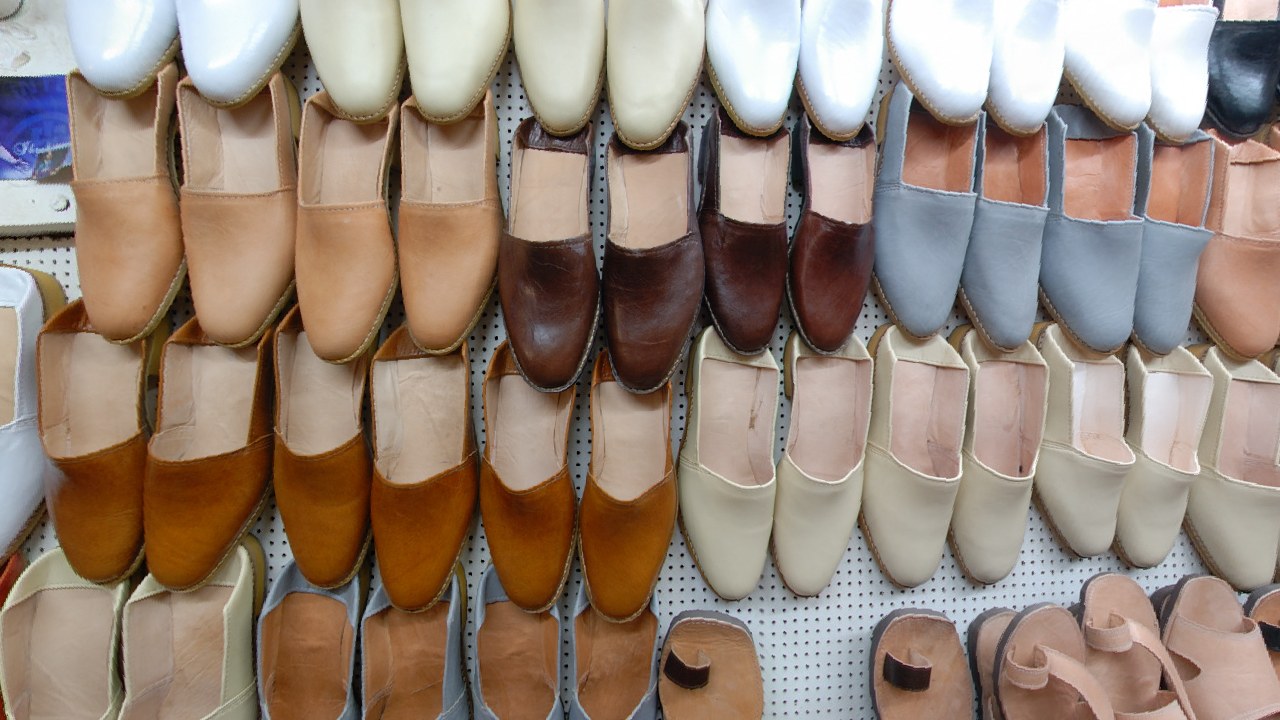
Its decline began with the adoption of European shoes. Although some shops have been taken over by the produce of Souk el Attarine, Souk el Blaghgia holds out. It has adapted its products to modern taste: alongside the traditional balgha, now a leisure shoe, it offers various models of mules. Pairs hang close together on parallel wooden slats, covering the walls with their shimmering colours.
The blaghgi's workshop-shop is deep. The craftsman works at his block, seated on a stool. "The shoemaker," says a text from 1860, "is the only craftsman who uses a stool; he alone does not work squatting. His seat is made of tiered branches." In the past the stool and the block were the emblem of the guild. When a journeyman became a master, the amine handed him a block, a gesture marking his entry into his new profession.
A short story: the four leather guilds
Leatherwork in Tunis involved four guilds.
The bchamquia made the bichmaq, a yellow or red pointed shoe with an upturned toe, reserved for notables. Their souk occupied today's rue Sidi Ben Ziad.
The cheberbia made the cherbella, a black leather slipper with yellow lining and rounded toes worn by women.
Another guild, the kontrajia, made kontra, black patent leather shoes with low quarters.
Finally the blaghgia formed the main guild, for among traditional footwear the babouche was the most common.
This struck Charles Lallemand, who wrote in 1890: "The Arab rides a horse, donkey or camel in his babouches. When he rides, his legs almost always dangle or are in perpetual motion, as if the rider were walking in the air. And surprisingly, his babouches, hanging from his toes with the soles away from his feet, never fall off: it is quite incomprehensible!"
Souk el Blaghgia
