Registered monuments
1. Sadiki College
Discoveries
2. Medersa el Bachia
Discoveries
3. Tunis City Hall
Discoveries
4. Municipal Theatre
Discoveries
5. Tourbet el Bey
Discoveries
6. Kasbah Mosque (Almohad Mosque)
Mosques and zawiyas
7. El Ksar Mosque
Mosques and zawiyas
8. Zitouna Mosque
Mosques and zawiyas
9. Hammouda Pacha Mosque
Mosques and zawiyas
10. Sahib el Tabaa Mosque
Mosques and zawiyas
11. Sidi Mehrez Mosque
Mosques and zawiyas
12. Youssef Dey Mosque
Mosques and zawiyas
13. Sidi Kacem Jellizi
Mosques and zawiyas
14. Zaouia Sidi Ali Chiha
Mosques and zawiyas
15. Zaouia Sidi Brahim Riahi
Mosques and zawiyas
16. Zaouia Sidi Mehrez
Mosques and zawiyas
17. Club Tahar Haddad
Palaces and houses
18. Dar Bach Hamba – Cultural Centre for the Mediterranean
Palaces and houses
19. Dar Ben Achour
Palaces and houses
20. Dar Ben Ammar
Palaces and houses
21. Dar Bouderbala – Galerie Médina
Palaces and houses
22. Dar el Haddad
Palaces and houses
23. Dar el Jaziri
Palaces and houses
24. Dar el Jeld – Gastronomy and Tradition
Palaces and houses
25. Dar el Médina
Palaces and houses
26. Dar Hammouda Pacha
Palaces and houses
27. Dar Hussein
Palaces and houses
28. Dar Lasram
Palaces and houses
29. Dar Othman
Palaces and houses
30. Dar Rachidia
Palaces and houses
31. Diwan Dar el Jeld
Palaces and houses
32. El Ali
Palaces and houses
33. Hotel Tunisia Palace
Palaces and houses
34. Calligrapher
Souks and crafts
35. Flag makers
Souks and crafts
36. El Makhzen
Souks and crafts
37. Blacksmith
Souks and crafts
38. The bransi at work
Souks and crafts
39. Diwan Bookshop
Souks and crafts
40. Carpenter
Souks and crafts
41. Souk Chaouachine
Souks and crafts
42. Souk el Attarine
Souks and crafts
43. Souk el Berka
Souks and crafts
44. Souk el Blaghgia
Souks and crafts
45. Souk el Blat
Souks and crafts
46. Souk el Fekka
Souks and crafts
47. Souk en Nhas
Souks and crafts
48. Souk et Trouk
Souks and crafts
Tunisia
History: the first City Hall of Tunis Dar Hussein stands on the site of the Ksar (palace) of the Beni Khorassan. In the Turkish period its fate was linked successively to three high-ranking mamluks. The first, Ismail Kahia, minister and son-in-law of Ali Pacha Bey (1758-1781), lived there until his…
360° virtual tour (4 scenes)
Location on the map
Dar Hussein – Headquarters of the National Heritage Institute
History: the first City Hall of Tunis
Dar Hussein stands on the site of the Ksar (palace) of the Beni Khorassan.
In the Turkish period its fate was linked successively to three high-ranking mamluks.
The first, Ismail Kahia, minister and son-in-law of Ali Pacha Bey (1758-1781), lived there until his disgrace and exile.
The second, Youssef Saheb el Tabaa, restored the palace for his planned marriage to Princess Fatma, sister of the ruler Hammouda Pacha, a marriage prevented by the minister's tragic death.
The third was General Hussein, who lived in the palace as President of the first municipal council, for the palace was chosen to house the municipality created in 1858.
In 1882 General Forgemol, who entered Tunis at the head of the occupying troops, decided to set up his headquarters in the municipal building, and the palace became the seat of the French military command until independence.
The Tunisian State then assigned it to the Heritage Institute.
The driba, followed by a sqifa, leads to the guest floor by a grand staircase. Wide, well lit and with a wrought-iron banister, it foreshadows the grand staircases of the Italianate palaces of the 19th century (Kheireddine Palace, Khaznadar Palace).
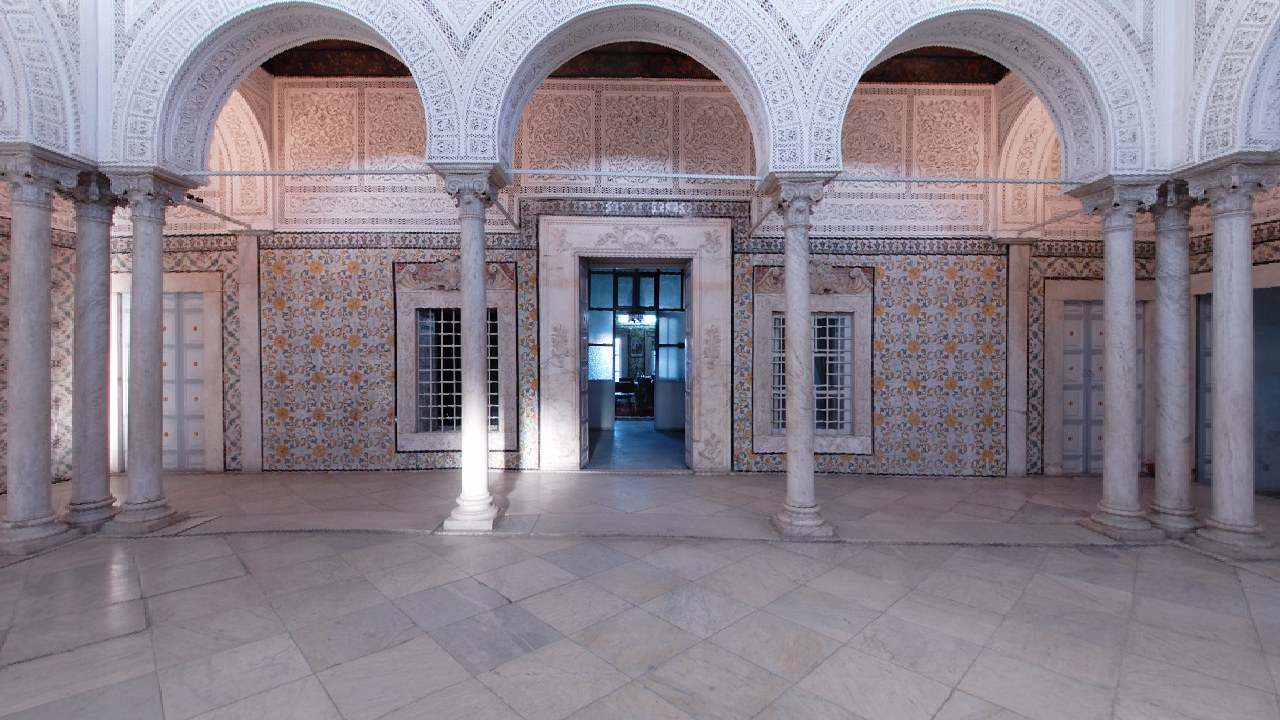
The upper patio has a graceful peristyle with marble columns, tripled at the corners. The baroque carved marble heavily adorning the window lintels is another sign of growing Italian influence. In the colonial period the patio was covered with a four-sided dome to serve as a reception room.
A short story: the procession for rain
When the French high command occupied Dar Hussein, the square took the name Place du Général. Guarded day and night by sentries, it was practically off-limits to non-residents.
The Mohsen family, neighbours of the "General", included several imams of the Great Mosque. One year, when a great drought struck the country, Imam Mohsen decided to perform the ritual prayers for rain. Followed by a large procession, the imam was to head out of the city to perform this special prayer.
The General, intrigued, asked about the gathering; when he learned the reason, he did not hide his disbelief. But some time later, seeing the procession return under heavy drops of rain, he had to admit his error. He then ordered his guard to play a salute in their honour.
04, place du Château, 1008 Tunis
Tel: +216 71 56 16 22
www.inp.rnrt.tn
