360° virtual tour (6 scenes)
Location on the map
Tourbet el Bey
History: a family funerary monument
In cemeteries, in Tunis and elsewhere, rows of tombs move us by their simplicity. Dazzling white, they stand out against the ochre earth when greenery is lacking.
The Turks, however, introduced the tourbet, a sumptuous funerary monument of a strictly family character. Tourbet el Bey is the largest and richest. This is hardly surprising, since it holds the tombs of the sovereigns of the Husseinite dynasty, their families and a few especially favoured mamluks and loyal ministers.
The monument was built during the reign of Ali Bey (1758-1781). It is announced by an imposing ochre sandstone façade with pilasters and entablatures in light stone, carved in low relief with Italianate floral motifs.
The straight entrance leads to a first courtyard surrounded by rooms, including the one called beit el bachaouet, the hall of the beys who actually reigned. It is a miniature replica of Ottoman mosques. Four large pillars support a central dome, buttressed by half-domes on the four sides, with four small domes completing the roof at the corners. The interior decoration perfectly combines carved plaster and Italianate polychrome marble inlay.
The tombs dug in the ground are covered with marble chests richly decorated in low relief, above which stand prismatic columns engraved with epitaphs and topped with headgear, indicating that the deceased was a man. The turban or tarbouch carved in stone reflects changes in the fashion of official dress.
Opposite lies the hall of the princesses' tombs. Two marble slabs, the one at the head engraved with an epitaph, mark these graves.
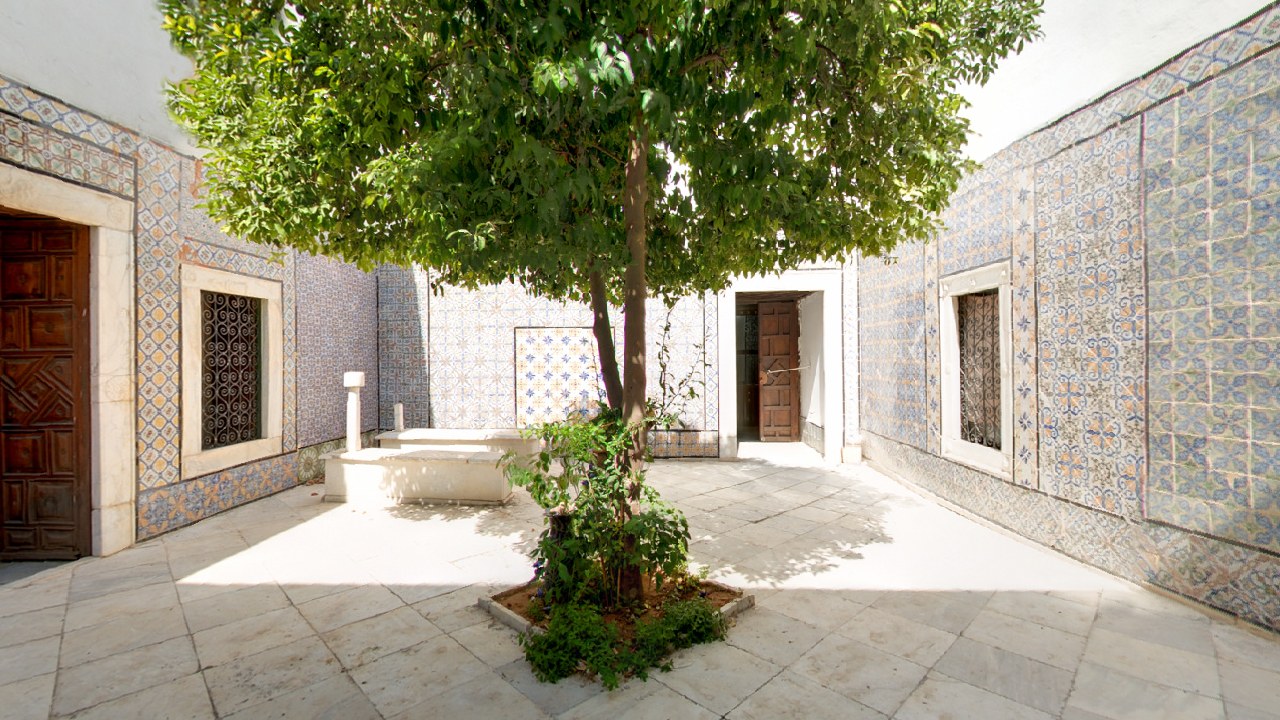
The second courtyard, where a fine lemon tree grows, is the result of a later extension. It is distinguished by an ovoid dome decorated with geometric motifs in extremely fine naqch hdida.
A short story: the funeral of Mohamed Bey, who died at the Bardo on 12 February 1759
"The body was taken to Tunis. All the inhabitants left their homes to join the procession, and the crowd stretched along the road from the Bardo to Sidi Ali Abdallah. The hachia carried the coffin, followed by the high dignitaries of the State and a great crowd unable to hold back its tears. The procession entered the city through the Sidi Ali Zouaoui gate; Mohamed Bey was buried in his father's tourba. Bags of money were then opened and their contents distributed to the poor." R. Dessort, Histoire de la ville de Tunis, Algiers, Pfister, 1924.
60, rue Tourbet el Bey