360° virtual tour (5 scenes)
Location on the map
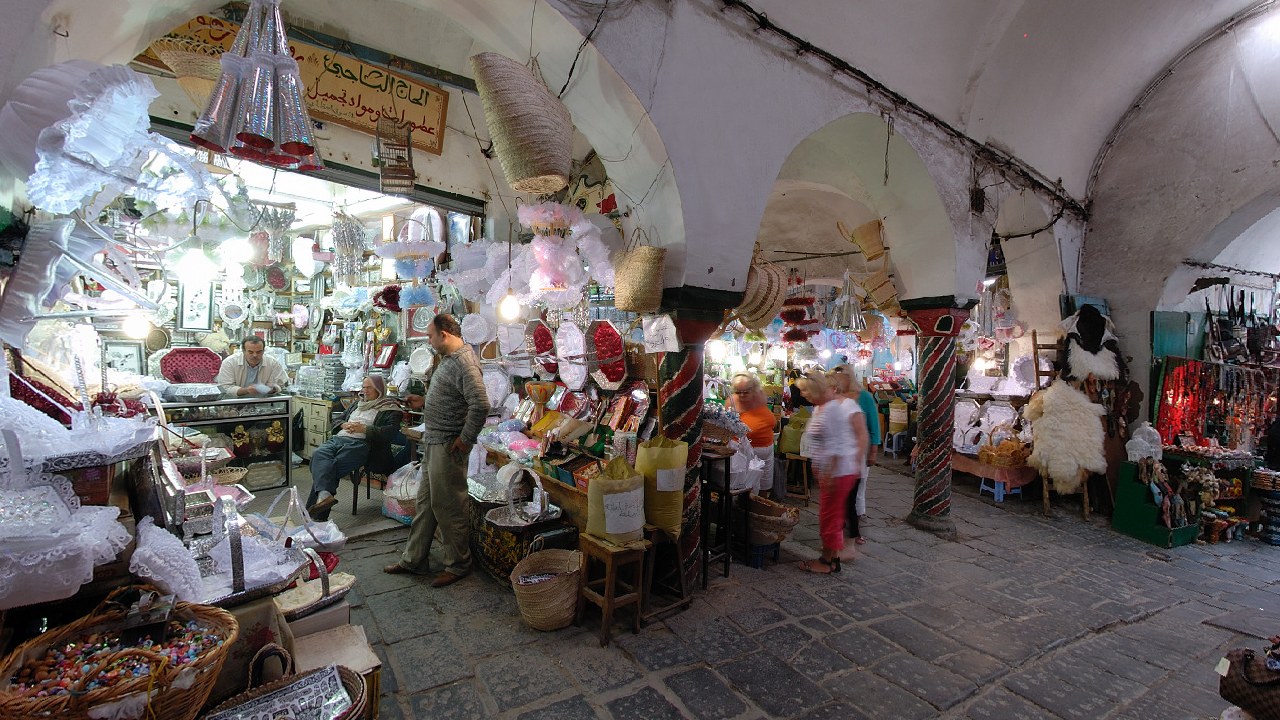
Souk el Attarine
The perfumers' souk was laid out along the northern façade of the Great Mosque by the Hafsid sultan Abu Zakariya around 1240. Since then hardly a traveller has failed to mention it.
Abdelbaset Khalil wrote in 1480: "Excellent perfumes are made in Tunis, such as we have never smelled anywhere else, from various flowers and fragrant herbs. The perfume merchants keep them in their shops in decorated flasks with long, narrow necks. In front of the Great Mosque of Tunis, more than a thousand ducats' worth of flowers are sold, from which pleasant perfumes are distilled, and they do not shun strong scents either."
Speaking of the women of Tunis, Leo Africanus (1526) stresses the importance of this souk: "The women are so refined and well turned out that they devote the greatest part of their care to perfumes and finery; so much so that the perfumers are the last to close their shops."
Let us also quote the account of Don Filippi (1830): "Of all the manufactures of the country, that of essences is the most perfected; indeed the nesseri (eglantine water) of Tunis is the most highly prized. Tunisians excel in distilling flowers, which are twice as productive as those of Europe; the Moors delight in them, and I will say with a witty writer: 'To watch these people with their long beards and great cloaks, silent and serious, with an exact balance, pouring the admirable essence drop by drop with an unerring hand, one seems to see time distilling pleasure and weighing the price of each small enjoyment.'"
A short story: Maison de Senteurs, an ancestral activity revisited
The shop opens at the foot of the Great Mosque. Its owner has given it special attention, restoring it faithfully to its original state. He refused any mezzanine or false ceiling and freed the brick and stone structure from the layers of plaster and whitewash that hid it.
The simplicity of the display cases suits the sobriety of the setting and showcases the products. These come from a company called Maison de Senteurs, which specialises in making beauty products from natural ingredients using scientific processes. It uses modern, distinctive packaging and is very successful at home and abroad.
Thus the built heritage is enhanced by an ancestral activity revisited and brought up to date.
