Registered monuments
1. Sadiki College
Discoveries
2. Medersa el Bachia
Discoveries
3. Tunis City Hall
Discoveries
4. Municipal Theatre
Discoveries
5. Tourbet el Bey
Discoveries
6. Kasbah Mosque (Almohad Mosque)
Mosques and zawiyas
7. El Ksar Mosque
Mosques and zawiyas
8. Zitouna Mosque
Mosques and zawiyas
9. Hammouda Pacha Mosque
Mosques and zawiyas
10. Sahib el Tabaa Mosque
Mosques and zawiyas
11. Sidi Mehrez Mosque
Mosques and zawiyas
12. Youssef Dey Mosque
Mosques and zawiyas
13. Sidi Kacem Jellizi
Mosques and zawiyas
14. Zaouia Sidi Ali Chiha
Mosques and zawiyas
15. Zaouia Sidi Brahim Riahi
Mosques and zawiyas
16. Zaouia Sidi Mehrez
Mosques and zawiyas
17. Club Tahar Haddad
Palaces and houses
18. Dar Bach Hamba – Cultural Centre for the Mediterranean
Palaces and houses
19. Dar Ben Achour
Palaces and houses
20. Dar Ben Ammar
Palaces and houses
21. Dar Bouderbala – Galerie Médina
Palaces and houses
22. Dar el Haddad
Palaces and houses
23. Dar el Jaziri
Palaces and houses
24. Dar el Jeld – Gastronomy and Tradition
Palaces and houses
25. Dar el Médina
Palaces and houses
26. Dar Hammouda Pacha
Palaces and houses
27. Dar Hussein
Palaces and houses
28. Dar Lasram
Palaces and houses
29. Dar Othman
Palaces and houses
30. Dar Rachidia
Palaces and houses
31. Diwan Dar el Jeld
Palaces and houses
32. El Ali
Palaces and houses
33. Hotel Tunisia Palace
Palaces and houses
34. Calligrapher
Souks and crafts
35. Flag makers
Souks and crafts
36. El Makhzen
Souks and crafts
37. Blacksmith
Souks and crafts
38. The bransi at work
Souks and crafts
39. Diwan Bookshop
Souks and crafts
40. Carpenter
Souks and crafts
41. Souk Chaouachine
Souks and crafts
42. Souk el Attarine
Souks and crafts
43. Souk el Berka
Souks and crafts
44. Souk el Blaghgia
Souks and crafts
45. Souk el Blat
Souks and crafts
46. Souk el Fekka
Souks and crafts
47. Souk en Nhas
Souks and crafts
48. Souk et Trouk
Souks and crafts
Tunisia
History: the shimmering greenery of the courtyard Othman Dey (1594–1611) had Dar Othman built for his personal use, leaving the official residence of the Kasbah, probably in search of calm, far from the intrigues of the then very unruly janissaries. He lived in the palace until his death. In the…
360° virtual tour (3 scenes)
Location on the map
Headquarters of the Conservation of the Medina of Tunis
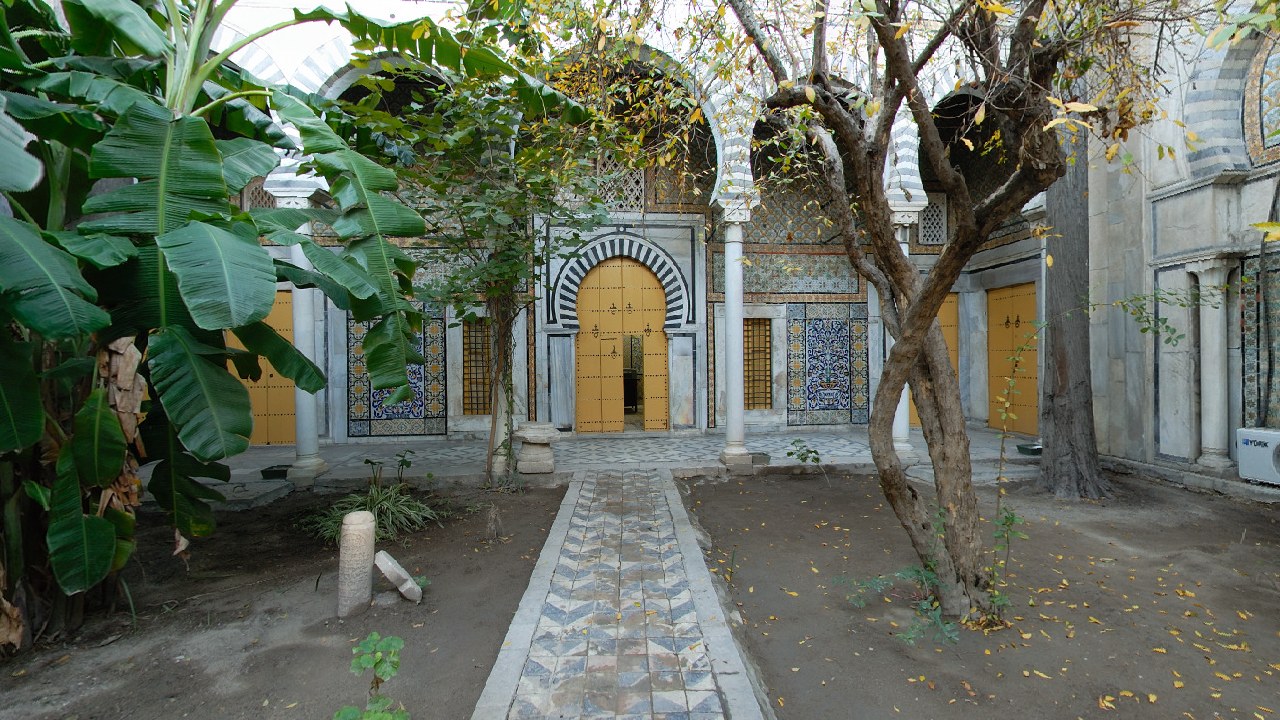
History: the shimmering greenery of the courtyard
Othman Dey (1594–1611) had Dar Othman built for his personal use, leaving the official residence of the Kasbah, probably in search of calm, far from the intrigues of the then very unruly janissaries. He lived in the palace until his death.
In the first half of the 19th century, Hussein Ben Mahmoud Bey also lived there after some works. But the house was soon abandoned. After several uses it was restored and now houses the Medina conservation services.
The driba of Dar Othman is a sumptuous vestibule, for it was here that the Dey received all those he could not admit into the privacy of his palace.
In 1936 the courtyard, having lost its paving, was turned into an inner garden, a happy effect in this very mineral medina. Underground cisterns that collect rainwater are usually found beneath courtyards, and planting them would risk damaging the cistern's waterproofing. That is why the shimmering greenery of the courtyard of Dar Othman is an exception.
Two facing porticoes of rare elegance are formed by five strongly horseshoe-shaped arches supported by long, graceful white marble columns with Hispano-Maghrebi capitals. The sequence of arches continues on the other two sides as blind arcading. Black and white voussoirs harmoniously link the whole. The austerity of the marble facings of the rooms is softened by the shimmering polychromy of the tile panels.
A short story: Dar el Oula
Dar el oula, or house of provisions, is one of the names of Dar Othman still known today. Standing empty, the palace, whose makhzen and outbuildings extended to the rue des Teinturiers, was used as a military supply depot for the Turkish barracks in the surrounding area: rue Sidi Ali Azouz, rue Jemaa el Zitouna, Souk el Attarine and rue Sidi Ben Ziad…
Less lasting was the name "House of the slaves". The palace was acquired by the Franco-African company on the eve of the Protectorate, which installed a manager named Achille Mangiavacchi. This curious character tried to spread an entirely fanciful legend that Dar Othman had been built by Christian slaves and had even been visited by Saint Vincent de Paul. An old photograph of the façade shows a statuette of the Virgin placed in a niche above the lintel of the main door.
The mysterious death of this character put an end to the tale. Was he murdered by a Muslim neighbour more fanatical than himself?
16 bis, rue el M'bazaâ
