Registered monuments
1. Sadiki College
Discoveries
2. Medersa el Bachia
Discoveries
3. Tunis City Hall
Discoveries
4. Municipal Theatre
Discoveries
5. Tourbet el Bey
Discoveries
6. Kasbah Mosque (Almohad Mosque)
Mosques and zawiyas
7. El Ksar Mosque
Mosques and zawiyas
8. Zitouna Mosque
Mosques and zawiyas
9. Hammouda Pacha Mosque
Mosques and zawiyas
10. Sahib el Tabaa Mosque
Mosques and zawiyas
11. Sidi Mehrez Mosque
Mosques and zawiyas
12. Youssef Dey Mosque
Mosques and zawiyas
13. Sidi Kacem Jellizi
Mosques and zawiyas
14. Zaouia Sidi Ali Chiha
Mosques and zawiyas
15. Zaouia Sidi Brahim Riahi
Mosques and zawiyas
16. Zaouia Sidi Mehrez
Mosques and zawiyas
17. Club Tahar Haddad
Palaces and houses
18. Dar Bach Hamba – Cultural Centre for the Mediterranean
Palaces and houses
19. Dar Ben Achour
Palaces and houses
20. Dar Ben Ammar
Palaces and houses
21. Dar Bouderbala – Galerie Médina
Palaces and houses
22. Dar el Haddad
Palaces and houses
23. Dar el Jaziri
Palaces and houses
24. Dar el Jeld – Gastronomy and Tradition
Palaces and houses
25. Dar el Médina
Palaces and houses
26. Dar Hammouda Pacha
Palaces and houses
27. Dar Hussein
Palaces and houses
28. Dar Lasram
Palaces and houses
29. Dar Othman
Palaces and houses
30. Dar Rachidia
Palaces and houses
31. Diwan Dar el Jeld
Palaces and houses
32. El Ali
Palaces and houses
33. Hotel Tunisia Palace
Palaces and houses
34. Calligrapher
Souks and crafts
35. Flag makers
Souks and crafts
36. El Makhzen
Souks and crafts
37. Blacksmith
Souks and crafts
38. The bransi at work
Souks and crafts
39. Diwan Bookshop
Souks and crafts
40. Carpenter
Souks and crafts
41. Souk Chaouachine
Souks and crafts
42. Souk el Attarine
Souks and crafts
43. Souk el Berka
Souks and crafts
44. Souk el Blaghgia
Souks and crafts
45. Souk el Blat
Souks and crafts
46. Souk el Fekka
Souks and crafts
47. Souk en Nhas
Souks and crafts
48. Souk et Trouk
Souks and crafts
Tunisia
History: in the beginning there was the Zitouna The Great Mosque occupies the heart of the city and is its organising element, from which the main streets radiate to the gates in the walls. Its foundation goes back to the governor Abdallah Ibn el-Habhab (732), or perhaps to Hassan Ibn Noomane, that…
360° virtual tour (7 scenes)
Location on the map
Zitouna Mosque
History: in the beginning there was the Zitouna
The Great Mosque occupies the heart of the city and is its organising element, from which the main streets radiate to the gates in the walls. Its foundation goes back to the governor Abdallah Ibn el-Habhab (732), or perhaps to Hassan Ibn Noomane, that is, to the very birth of the Medina, which succeeded Carthage in 698.
This debate matters little, for we know that on the orders of the Aghlabid emir Ibn Ahmed, the first mosque was completely rebuilt, enlarged and embellished; it then took on broadly the appearance we know today.
Like the earlier mosques of Cordoba and Kairouan, it consists of a hypostyle prayer hall preceded by a courtyard. The whole covers about 5,000 m², of which 1,344 m² are roofed. The timber ceiling rests on 184 ancient columns and capitals, defining 15 naves and 6 bays.
The space in front of the mihrab is marked by a dome bearing an inscription dating it to 864. From outside, the dome is a fluted hemispherical cap in the pure Aghlabid tradition.
Since then, every dynasty has wished to leave its mark here.
The Zirids (10th century) added the narthex gallery and the beautiful dome of the bahou.
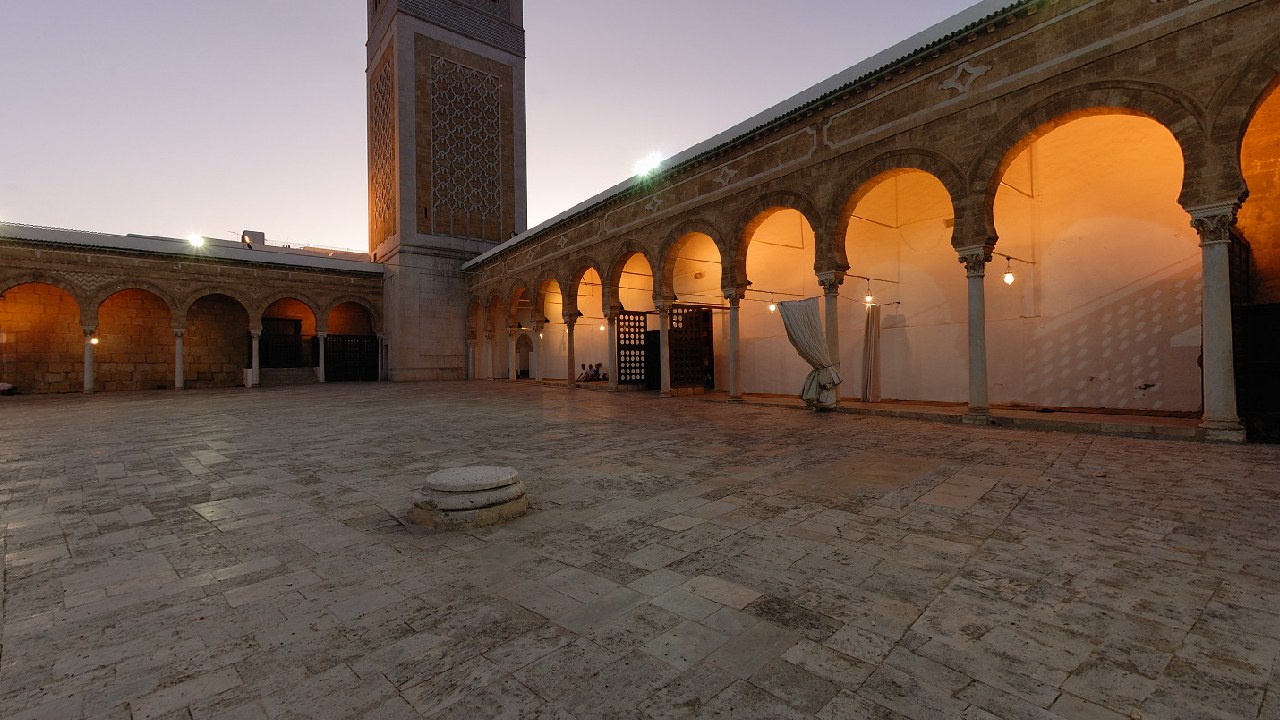
In 1316 the Hafsid sultan Abu Yahya Zakariya closed off the prayer hall with a series of wooden doors, gave the courtyard three surrounding galleries and added outside, in front of the east façade, a courtyard that was roofed over in the 17th century. Today it forms a fine double-arcaded gallery reached by a wide staircase. The back wall of this gallery preserves a section of 9th-century wall built of large stone blocks, flanked at the north-east corner by a round tower that bears witness to the defensive role of the early mosques.
The Turks renewed the decoration of the prayer hall with carved plaster. In the mid-19th century the minister Khaznadar adorned three sides of the courtyard with white marble columns and composite capitals imported directly from Carrara (Italy).
The last addition to this prestigious monument was a new minaret (1894). It replaced the 17th-century minaret which, owing to the spread of housing, no longer dominated the city. The new minaret, 43 m high, is the work of two great master masons, Sliman Nigrou and Tahar Ibn Saber. Its form and decoration are borrowed from the Almohad minaret of the Kasbah, which has been the model since the 13th century.
A short story: Zitouna teaching
From the 13th century the Hafsids gave new impetus to teaching. The medersa, an institution newly introduced to the Maghreb, offered students lodging. The Great Mosque stood out as a brilliant university centre.
The traveller Khaled el Balawi (1330-1340) expressed his admiration for the number of eminent jurists, among them the cadis Ibn el Rafii and Ibn el Salam and the illustrious Ibn Arafa. The rivalry between the latter and the great scholar Ibn Khaldun has gone down in history; it simply reflects the intellectual vitality of the time.
According to the chroniclers, the Spanish occupation (1535-1574) was disastrous for teaching and learning. The library of the Great Mosque, which then held no fewer than 30,000 works, was ransacked. Not until the early 18th century, with Hussein Ben Ali and his successor Ali Pacha, did teaching revive; it was reorganised thanks to the reforms of Ahmed Bey (1842).
Among the illustrious scholars of the last generation trained at the Zitouna, it is enough to name the theologian Mohamed Tahar Ben Achour and the poet Abou el Kacem el Chebbi.
One cannot speak of the Zitouna scholars without recalling their active part in the national struggle.
Six of them fell under the fire of the French authorities during a demonstration on 15 March 1952.
But the most surprising event took place a month earlier, on 2 February, when a group of women, including ladies of the bourgeoisie such as Princess Fatma, granddaughter of Moncef Bey, as well as women of the people, decided to stage a sit-in inside the Great Mosque and went on a hunger strike that lasted three days.
Rue Jemaa Zitouna
