Registered monuments
1. Sadiki College
Discoveries
2. Medersa el Bachia
Discoveries
3. Tunis City Hall
Discoveries
4. Municipal Theatre
Discoveries
5. Tourbet el Bey
Discoveries
6. Kasbah Mosque (Almohad Mosque)
Mosques and zawiyas
7. El Ksar Mosque
Mosques and zawiyas
8. Zitouna Mosque
Mosques and zawiyas
9. Hammouda Pacha Mosque
Mosques and zawiyas
10. Sahib el Tabaa Mosque
Mosques and zawiyas
11. Sidi Mehrez Mosque
Mosques and zawiyas
12. Youssef Dey Mosque
Mosques and zawiyas
13. Sidi Kacem Jellizi
Mosques and zawiyas
14. Zaouia Sidi Ali Chiha
Mosques and zawiyas
15. Zaouia Sidi Brahim Riahi
Mosques and zawiyas
16. Zaouia Sidi Mehrez
Mosques and zawiyas
17. Club Tahar Haddad
Palaces and houses
18. Dar Bach Hamba – Cultural Centre for the Mediterranean
Palaces and houses
19. Dar Ben Achour
Palaces and houses
20. Dar Ben Ammar
Palaces and houses
21. Dar Bouderbala – Galerie Médina
Palaces and houses
22. Dar el Haddad
Palaces and houses
23. Dar el Jaziri
Palaces and houses
24. Dar el Jeld – Gastronomy and Tradition
Palaces and houses
25. Dar el Médina
Palaces and houses
26. Dar Hammouda Pacha
Palaces and houses
27. Dar Hussein
Palaces and houses
28. Dar Lasram
Palaces and houses
29. Dar Othman
Palaces and houses
30. Dar Rachidia
Palaces and houses
31. Diwan Dar el Jeld
Palaces and houses
32. El Ali
Palaces and houses
33. Hotel Tunisia Palace
Palaces and houses
34. Calligrapher
Souks and crafts
35. Flag makers
Souks and crafts
36. El Makhzen
Souks and crafts
37. Blacksmith
Souks and crafts
38. The bransi at work
Souks and crafts
39. Diwan Bookshop
Souks and crafts
40. Carpenter
Souks and crafts
41. Souk Chaouachine
Souks and crafts
42. Souk el Attarine
Souks and crafts
43. Souk el Berka
Souks and crafts
44. Souk el Blaghgia
Souks and crafts
45. Souk el Blat
Souks and crafts
46. Souk el Fekka
Souks and crafts
47. Souk en Nhas
Souks and crafts
48. Souk et Trouk
Souks and crafts
Tunisia
Dar el Jaziri was built in the 18th century by a wealthy landowning family. It is famous for having hosted the second congress of the Neo-Destour (30 October–2 November 1937). These meetings, then clandestine, were held in the large courtyards of houses, unknown to the colonial authorities. For…
360° virtual tour (4 scenes)
Location on the map
Dar el Jaziri – House of Poetry
Dar el Jaziri was built in the 18th century by a wealthy landowning family.
It is famous for having hosted the second congress of the Neo-Destour (30 October–2 November 1937). These meetings, then clandestine, were held in the large courtyards of houses, unknown to the colonial authorities. For this reason Dar el Jaziri was acquired by the State and became a historic monument. Today it is dedicated to poetry: poets' gatherings, poetry contests and a specialised library make the dar a major cultural venue.
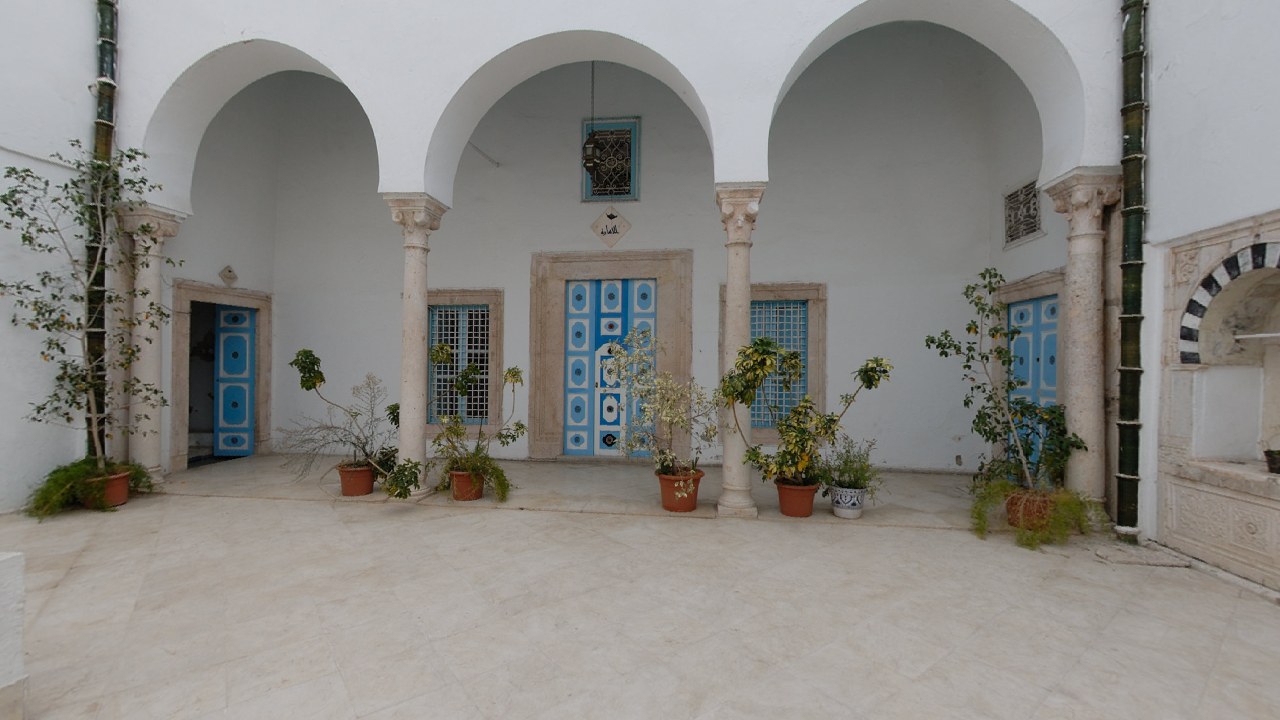
The courtyard, with two facing porticoes, has gained in sobriety by losing its wall tiles. This sobriety is accentuated by the exclusive use of kadhal (limestone), found in the paving, the columns and capitals, the door and window frames, the well curb and the cistern niche.
To feed rainwater from the terraces into the underground cistern, four mizab (vertical pipes of green glazed pottery) run down the four corners of the courtyard into the underground reservoirs.
The perfect symmetry of the doors and windows and their woodwork painted in soft shades of blue give this bright courtyard a soothing atmosphere.
In the rooms, which have lost their wall coverings and much of their stucco frieze, the eye is drawn only by the beauty of the painted wooden ceilings. The exposed joists are adorned with Italianate floral motifs framing Hispano-Moorish geometric elements.
More elaborate is the decorative composition of the coffered ceiling of the kbou, with a central rectangular motif framed by borders, the whole strewn with flowers. The illuminations of the ceilings continue in the canopies of the side alcoves. These fixed furnishings were designed and made when the rooms themselves were built, hence their complete harmony with the ceilings.
29, rue du Tribunal
