360° virtual tour (7 scenes)
Location on the map
Dar Bach Hamba – Cultural Centre for the Mediterranean
History: evidence of the kinship of Mediterranean cultures
The Bach Hamba, military dignitaries of Turkish origin, gave their name to the house that was theirs until 1923. In that year the Franciscan sisters acquired it for a foundation whose aim was "to help and educate the native population".
The charitable institution no longer exists and the house has found a cultural vocation. Since 2000 the Orestiadi Foundation, based in Sicily, has run the Cultural Centre for the Mediterranean at Dar Bach Hamba. The museum offers a fine selection of ceramics, pottery, textiles and costumes, testifying to the astonishing kinship of Mediterranean cultures. Exhibitions, concerts and lectures attract enthusiasts from everywhere, without neglecting the inhabitants of the district.
The driba (first vestibule) is usually followed by one or more skifas arranged in a bent passage to isolate the courtyard from the street. Here the driba leads to an open-air space, the rwa, serving the inner stables and allowing the owners to enter by carriage or on horseback. Today greenery enhances the beauty of the stone.
The makhzen, once the stables and/or storerooms of the Bach Hamba family, has taken on nobler functions suited to meditation and reflection. After being turned into a chapel by the sisters, it is now a multipurpose hall for the cultural activities of the Orestiadi Foundation.
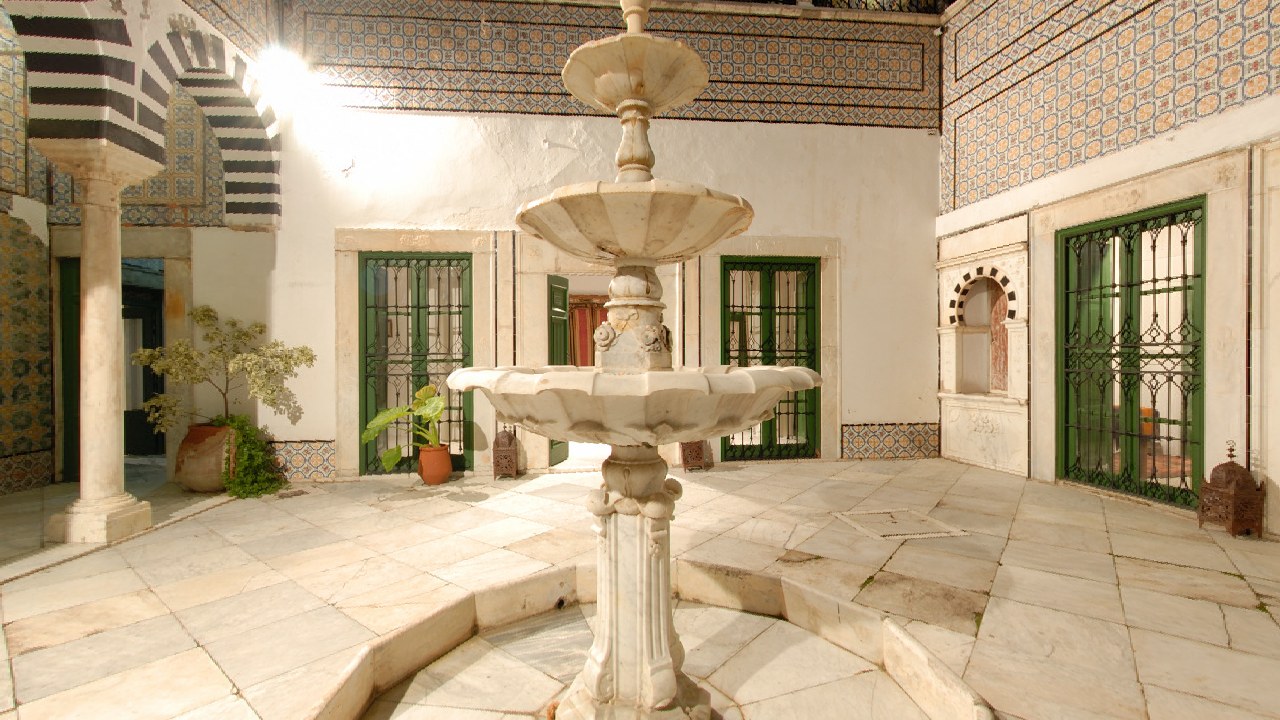
The main courtyard proudly displays its immaculate marble imported from Carrara: paving, door and window frames, columns with neoclassical capitals, central basin, cistern niche. The painted wooden ceilings of the rooms are Italianate in style.
Like every important house, Dar Bach Hamba has its ali el dhiaf, or guest floor. Its small courtyard covered by a glass roof and its rooms opening wide onto the terraces make it an ideal place for a museum. One cannot leave this floor without admiring the coffered wooden ceiling with its skilfully intertwined profusion of floral decoration.
A short story: in the days of the Franciscan sisters
The school run by the Franciscan sisters took in Tunisian girls from the age of five to learn sewing, embroidery, childcare and cooking, in short everything that would make them good mothers. A dispensary also cared for the poor. But as Tunisia progressed, girls apparently preferred to receive the same education as boys, and the sick preferred the many public health centres.
9, rue Bach Hamba
Tel: +216 71 32 51 15
www.orestiadi.it
