Registered monuments
1. Sadiki College
Discoveries
2. Medersa el Bachia
Discoveries
3. Tunis City Hall
Discoveries
4. Municipal Theatre
Discoveries
5. Tourbet el Bey
Discoveries
6. Kasbah Mosque (Almohad Mosque)
Mosques and zawiyas
7. El Ksar Mosque
Mosques and zawiyas
8. Zitouna Mosque
Mosques and zawiyas
9. Hammouda Pacha Mosque
Mosques and zawiyas
10. Sahib el Tabaa Mosque
Mosques and zawiyas
11. Sidi Mehrez Mosque
Mosques and zawiyas
12. Youssef Dey Mosque
Mosques and zawiyas
13. Sidi Kacem Jellizi
Mosques and zawiyas
14. Zaouia Sidi Ali Chiha
Mosques and zawiyas
15. Zaouia Sidi Brahim Riahi
Mosques and zawiyas
16. Zaouia Sidi Mehrez
Mosques and zawiyas
17. Club Tahar Haddad
Palaces and houses
18. Dar Bach Hamba – Cultural Centre for the Mediterranean
Palaces and houses
19. Dar Ben Achour
Palaces and houses
20. Dar Ben Ammar
Palaces and houses
21. Dar Bouderbala – Galerie Médina
Palaces and houses
22. Dar el Haddad
Palaces and houses
23. Dar el Jaziri
Palaces and houses
24. Dar el Jeld – Gastronomy and Tradition
Palaces and houses
25. Dar el Médina
Palaces and houses
26. Dar Hammouda Pacha
Palaces and houses
27. Dar Hussein
Palaces and houses
28. Dar Lasram
Palaces and houses
29. Dar Othman
Palaces and houses
30. Dar Rachidia
Palaces and houses
31. Diwan Dar el Jeld
Palaces and houses
32. El Ali
Palaces and houses
33. Hotel Tunisia Palace
Palaces and houses
34. Calligrapher
Souks and crafts
35. Flag makers
Souks and crafts
36. El Makhzen
Souks and crafts
37. Blacksmith
Souks and crafts
38. The bransi at work
Souks and crafts
39. Diwan Bookshop
Souks and crafts
40. Carpenter
Souks and crafts
41. Souk Chaouachine
Souks and crafts
42. Souk el Attarine
Souks and crafts
43. Souk el Berka
Souks and crafts
44. Souk el Blaghgia
Souks and crafts
45. Souk el Blat
Souks and crafts
46. Souk el Fekka
Souks and crafts
47. Souk en Nhas
Souks and crafts
48. Souk et Trouk
Souks and crafts
Tunisia
History: between Ifriqiyan and Andalusian art Kacem el Jellizi, whose real name was Abou el Fadhl Kacem el Fessi (from Fez), probably owes his name to the craft of jelliz (ceramic tiles), which he practised with rare technical skill and a great sense of beauty. Tradition gives him Andalusian…
360° virtual tour (5 scenes)
Location on the map
Sidi Kacem Jellizi
History: between Ifriqiyan and Andalusian art
Kacem el Jellizi, whose real name was Abou el Fadhl Kacem el Fessi (from Fez), probably owes his name to the craft of jelliz (ceramic tiles), which he practised with rare technical skill and a great sense of beauty. Tradition gives him Andalusian origins.
An artist who was also very devout, he was raised to the rank of saint, venerated by the population and esteemed by the Hafsid sultans.
When he died in 1496, the Sultan himself attended his funeral. Buried in his own house, it soon became a place of worship, a zaouia, where people still come seeking the saint's baraka! The building was restored several times, but the most important work is due to Abou el Ghaith el Kachech, sheikh of the Andalusians of Tunis, who made the zaouia a shelter for the Moriscos expelled from Spain.
In the early 18th century Hussein Ben Ali added a mosque to the complex, which now houses a modern ceramics workshop.
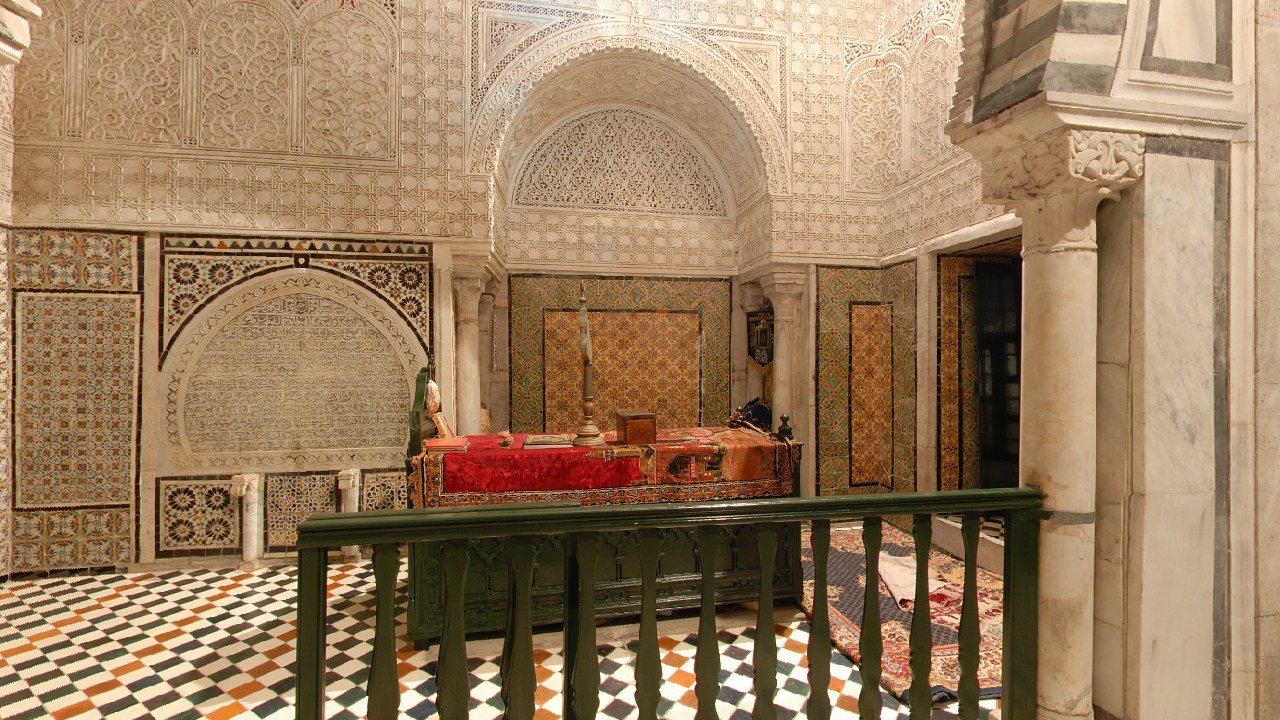
The monument has a magnificent porticoed courtyard, dominated on one side by the imposing silhouette of the funerary chamber, while the other three sides are lined with rooms originally reserved for the poor and for pilgrims.
The dome is an architectural jewel expressing a harmonious blend of Ifriqiyan and Andalusian art. The interior decoration displays the two-tone black and white marble arches, the cobweb-fine arabesques of carved plaster and the shimmering wall tiles made using the cuerda seca technique.
From outside, the pyramidal roof covered with green glazed tiles recalls Hispano-Moorish monuments, while the flat-backed niches and the use of stone masonry are purely local.
After a restoration campaign completed in 1981 with the help of the Spanish government, the monument houses, without disturbing worship, a museum of Tunisian ceramics and the National Centre for Artistic Ceramics, which trains future ceramists.
A short story: the Moriscos expelled from Spain
"The Moriscos, judged undesirable by Philip III, were expelled from Spain and flocked to the Regency (1609). Many town-dwellers settled in Tunis, not without shocking the inhabitants with their dress and their language… How could such infidel appearances suit good Muslims?
Credit must go to Othman Dey, who treated them as such and gave them the warmest welcome, and to the pious Sidi Belghith el Kachech, who saw to their settlement. His own zaouia, that of Sidi Kacem, served as a transit point until more comfortable shelter was found for them, readily offered by the families of Tunis.
Little by little they gathered in two districts, one around today's rue des Andalous, the other in houmet el andalous, the Andalusian quarter, near Tronja and Hammam el Remimi." (Jamila Binous – Tunis à l'ombre de ses remparts).
31, rue Sidi Kacem Jellizi
Tel: +216 71 57 24 23
