Registered monuments
1. Sadiki College
Discoveries
2. Medersa el Bachia
Discoveries
3. Tunis City Hall
Discoveries
4. Municipal Theatre
Discoveries
5. Tourbet el Bey
Discoveries
6. Kasbah Mosque (Almohad Mosque)
Mosques and zawiyas
7. El Ksar Mosque
Mosques and zawiyas
8. Zitouna Mosque
Mosques and zawiyas
9. Hammouda Pacha Mosque
Mosques and zawiyas
10. Sahib el Tabaa Mosque
Mosques and zawiyas
11. Sidi Mehrez Mosque
Mosques and zawiyas
12. Youssef Dey Mosque
Mosques and zawiyas
13. Sidi Kacem Jellizi
Mosques and zawiyas
14. Zaouia Sidi Ali Chiha
Mosques and zawiyas
15. Zaouia Sidi Brahim Riahi
Mosques and zawiyas
16. Zaouia Sidi Mehrez
Mosques and zawiyas
17. Club Tahar Haddad
Palaces and houses
18. Dar Bach Hamba – Cultural Centre for the Mediterranean
Palaces and houses
19. Dar Ben Achour
Palaces and houses
20. Dar Ben Ammar
Palaces and houses
21. Dar Bouderbala – Galerie Médina
Palaces and houses
22. Dar el Haddad
Palaces and houses
23. Dar el Jaziri
Palaces and houses
24. Dar el Jeld – Gastronomy and Tradition
Palaces and houses
25. Dar el Médina
Palaces and houses
26. Dar Hammouda Pacha
Palaces and houses
27. Dar Hussein
Palaces and houses
28. Dar Lasram
Palaces and houses
29. Dar Othman
Palaces and houses
30. Dar Rachidia
Palaces and houses
31. Diwan Dar el Jeld
Palaces and houses
32. El Ali
Palaces and houses
33. Hotel Tunisia Palace
Palaces and houses
34. Calligrapher
Souks and crafts
35. Flag makers
Souks and crafts
36. El Makhzen
Souks and crafts
37. Blacksmith
Souks and crafts
38. The bransi at work
Souks and crafts
39. Diwan Bookshop
Souks and crafts
40. Carpenter
Souks and crafts
41. Souk Chaouachine
Souks and crafts
42. Souk el Attarine
Souks and crafts
43. Souk el Berka
Souks and crafts
44. Souk el Blaghgia
Souks and crafts
45. Souk el Blat
Souks and crafts
46. Souk el Fekka
Souks and crafts
47. Souk en Nhas
Souks and crafts
48. Souk et Trouk
Souks and crafts
Tunisia
History: a rich and generous mamluk The founder of this mosque, Youssef Sahib el Tabaa, was a mamluk of Moldavian origin, bought in Istanbul for Baccar el Jellouli, caid of Sfax, who presented him to Hammouda Pacha Bey on his accession to the throne. Raised at court, he was said to be intelligent,…
360° virtual tour (4 scenes)
Location on the map
Sahib el Tabaa Mosque
History: a rich and generous mamluk
The founder of this mosque, Youssef Sahib el Tabaa, was a mamluk of Moldavian origin, bought in Istanbul for Baccar el Jellouli, caid of Sfax, who presented him to Hammouda Pacha Bey on his accession to the throne. Raised at court, he was said to be intelligent, just and generous. He won the esteem of the sovereign, who appointed him keeper of the seals, or sahib el tabaa.
The mosque whose construction he financed was part of a vast programme comprising two medersas and a tourbet adjoining the place of worship; a hammam, where the film "Halfaouine, Boy of the Terraces" was shot; a foundouk; a souk; and, overlooking the square, his own palace. The operation aimed to develop the northern suburb, a district chosen for its proximity to the Bardo, seat of the court, where Sahib el Tabaa went daily to assist the Bey in running the affairs of State. Later, other mamluks chose this district to build their palaces, such as Khaznadar and Caïd el Sebsi.
The Italian influence seen in 18th-century monuments in Tunis is clearer here. This is explained by a workforce made up largely of Italian slaves who fell into the hands of Tunisian corsairs during the attack on the Sardinian island of San Pietro on 2 September 1798. The archives have kept a list of 27 Italian slaves whom Hammouda Pacha placed at his minister's disposal for the Halfaouine mosque project. The marble was specially cut and carried from Livorno to Tunis on one of Sahib el Tabaa's ships, which he gave to Captain Hassouna el Mourali in thanks for his services at the end of the work.
The master mason (amine) Sassi Ben Frija supervised the construction of the mosque, whose plan is inspired by that of the Muradid Hammouda Pacha Mosque. We find the three galleries preceded by courtyards framing the prayer hall. The east courtyard, with a double gallery and a mihrab, is used for prayer in summer.
The octagonal minaret, left unfinished after the founder's assassination in 1815, remained so until 1968 because of a superstition that predicted the same tragic death for anyone who dared complete the tower.
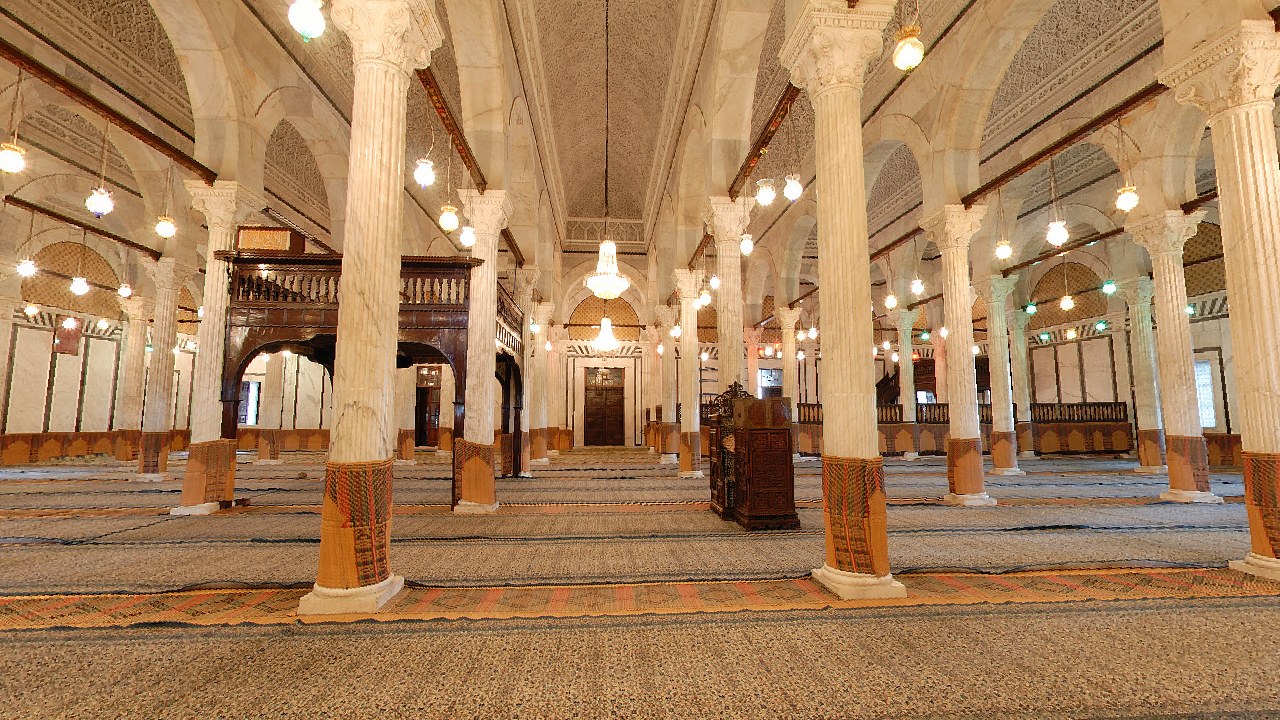
The prayer hall is covered with barrel vaults whose carved plaster is the only reference to local art. Elsewhere the most precious marbles are combined: the dazzling white of the fluted columns, the pink, red and brown marble inlay of the mihrab and the minbar…
A short story: the career and end of a mamluk
A mamluk was a young Christian slave, converted to Islam, who received a solid education preparing him for positions of responsibility.
The female equivalent of the mamluk was the odalisque, confined to the role of favourite, providing pleasure and ensuring the quality and beauty of the offspring. Few played a political role (see Faïcal Bey's The Last Odalisque).
Cut off from their origins, mamluks lost all lineage. They were given a Muslim first name and their title as a surname, which they passed on to their descendants as a family name. Hence today's families Khaznadar (treasurer), Caïd el Sebsi (keeper of the bey's pipe), Khojet el Khlil (master of the stables), Bach Baouab (head porter), and the list goes on.
Youssef Sahib el Tabaa also had a considerable fortune for, besides his duties at court, he did business in trade: "in every speculation he proves a dangerous competitor," an English traveller said of him, "and few individuals dare compete with him, not only in Tunis but also in the markets of France and Italy". He also fitted out privateering ships, then a lawful and lucrative activity.
At the height of his glory, and still very influential after the death of his protector Hammouda Pacha, he inevitably aroused the jealousy and hatred of the courtiers of the Bardo. He was accused of plotting against the prince and the security of the State. The Bey decided to summon him to question him in the presence of his accusers.
Fearing this confrontation, the conspirators prevented it by stabbing Youssef Sahib el Tabaa to death in the corridor leading to the audience hall, claiming that he had just declared revolt against the Bey.
His body was handed over to the mob, roused by gold distributed by his enemies and by the rumour, of course groundless, of his treason and collusion with the Christians. His mutilated body was dragged through the streets of Tunis and finally thrown into the Christian cemetery. It took the intercession of the holy man Sidi Brahim Riahi with the Bey for the minister's family to be allowed to bury his remains in the tourbet he had built in the Halfaouine mosque.
Place Halfaouine
