Registered monuments
1. Sadiki College
Discoveries
2. Medersa el Bachia
Discoveries
3. Tunis City Hall
Discoveries
4. Municipal Theatre
Discoveries
5. Tourbet el Bey
Discoveries
6. Kasbah Mosque (Almohad Mosque)
Mosques and zawiyas
7. El Ksar Mosque
Mosques and zawiyas
8. Zitouna Mosque
Mosques and zawiyas
9. Hammouda Pacha Mosque
Mosques and zawiyas
10. Sahib el Tabaa Mosque
Mosques and zawiyas
11. Sidi Mehrez Mosque
Mosques and zawiyas
12. Youssef Dey Mosque
Mosques and zawiyas
13. Sidi Kacem Jellizi
Mosques and zawiyas
14. Zaouia Sidi Ali Chiha
Mosques and zawiyas
15. Zaouia Sidi Brahim Riahi
Mosques and zawiyas
16. Zaouia Sidi Mehrez
Mosques and zawiyas
17. Club Tahar Haddad
Palaces and houses
18. Dar Bach Hamba – Cultural Centre for the Mediterranean
Palaces and houses
19. Dar Ben Achour
Palaces and houses
20. Dar Ben Ammar
Palaces and houses
21. Dar Bouderbala – Galerie Médina
Palaces and houses
22. Dar el Haddad
Palaces and houses
23. Dar el Jaziri
Palaces and houses
24. Dar el Jeld – Gastronomy and Tradition
Palaces and houses
25. Dar el Médina
Palaces and houses
26. Dar Hammouda Pacha
Palaces and houses
27. Dar Hussein
Palaces and houses
28. Dar Lasram
Palaces and houses
29. Dar Othman
Palaces and houses
30. Dar Rachidia
Palaces and houses
31. Diwan Dar el Jeld
Palaces and houses
32. El Ali
Palaces and houses
33. Hotel Tunisia Palace
Palaces and houses
34. Calligrapher
Souks and crafts
35. Flag makers
Souks and crafts
36. El Makhzen
Souks and crafts
37. Blacksmith
Souks and crafts
38. The bransi at work
Souks and crafts
39. Diwan Bookshop
Souks and crafts
40. Carpenter
Souks and crafts
41. Souk Chaouachine
Souks and crafts
42. Souk el Attarine
Souks and crafts
43. Souk el Berka
Souks and crafts
44. Souk el Blaghgia
Souks and crafts
45. Souk el Blat
Souks and crafts
46. Souk el Fekka
Souks and crafts
47. Souk en Nhas
Souks and crafts
48. Souk et Trouk
Souks and crafts
Tunisia
History: the majesty of a great house Dar Hammouda Pacha, built by the Muradid ruler Hammouda Pacha around the middle of the 17th century, passed to the Chahed family from 1872. In 1995 the family sold it to the Poulina group, which undertook major restoration work and finally devoted it to the…
360° virtual tour (4 scenes)
Location on the map
Dar Hammouda Pacha – Receptions and banquets
History: the majesty of a great house
Dar Hammouda Pacha, built by the Muradid ruler Hammouda Pacha around the middle of the 17th century, passed to the Chahed family from 1872. In 1995 the family sold it to the Poulina group, which undertook major restoration work and finally devoted it to the culinary arts.
As in every great house, one enters through a driba followed by two sqifas in a bent passage, isolating the courtyard from prying eyes, noise and any other disturbance from the street.
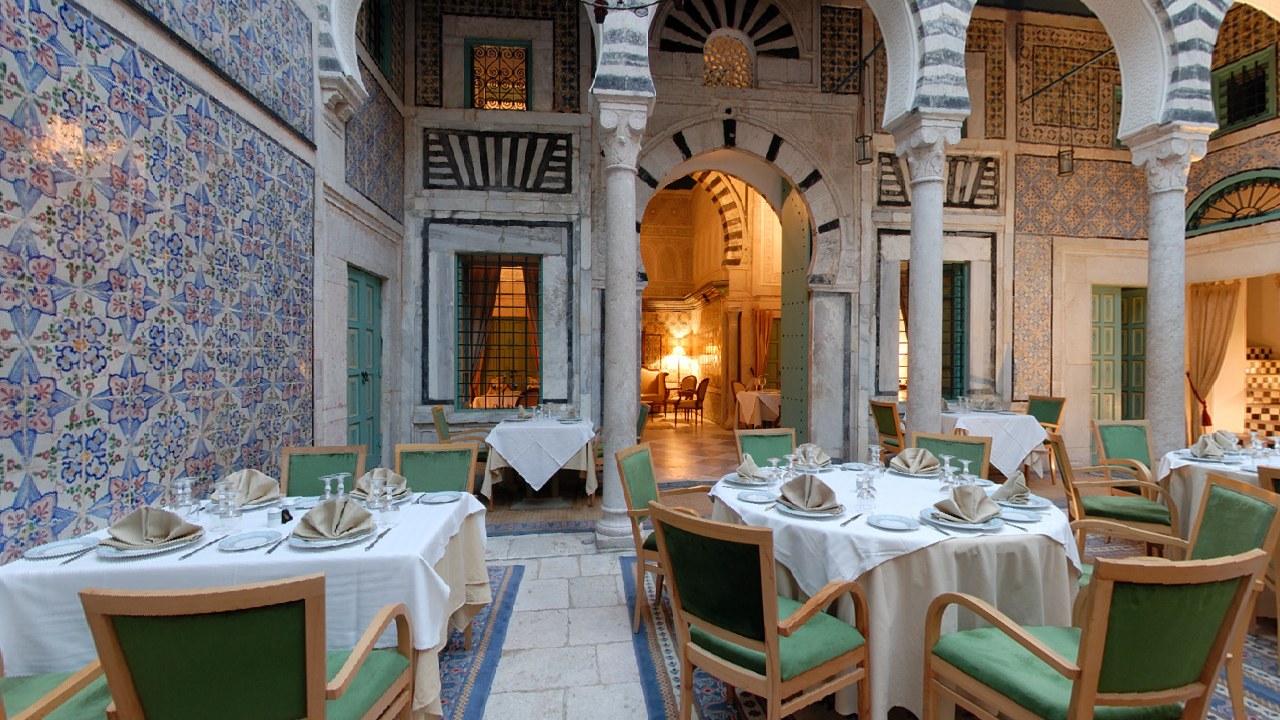
At the end of this passage, a majestic courtyard appears. Here we find the alternating courses in the arches and the lintels of doors and windows typical of Muradid architecture, but the stone facing has largely been replaced by mainly blue ceramics, following the Husseinite fashion developed by the beylical court. Kadhal stone nonetheless remains predominant: courtyard paving, columns and capitals, door and window frames. This stone would soon be supplanted by white marble imported from Italy.
A short story: for the love of a favourite
A well-established oral tradition holds that the great ruler Hammouda Pacha had this beautiful house built to lodge his favourite, not far from the Kasbah, seat of government, so that he could visit at leisure.
"No," say other sources: the house was lived in by Princess Aziza Othmana, the great benefactress of Tunis, who is said to have been Hammouda Pacha's wife.
But why insist on establishing the historical truth? Let us simply say that love lay behind this magnificent architectural work, whether passionate love for a favourite or the wiser conjugal love for a great lady in the history of Tunis.
56, rue Sidi Ben Arous
Tel: +216 71 56 65 84
