Registered monuments
1. Sadiki College
Discoveries
2. Medersa el Bachia
Discoveries
3. Tunis City Hall
Discoveries
4. Municipal Theatre
Discoveries
5. Tourbet el Bey
Discoveries
6. Kasbah Mosque (Almohad Mosque)
Mosques and zawiyas
7. El Ksar Mosque
Mosques and zawiyas
8. Zitouna Mosque
Mosques and zawiyas
9. Hammouda Pacha Mosque
Mosques and zawiyas
10. Sahib el Tabaa Mosque
Mosques and zawiyas
11. Sidi Mehrez Mosque
Mosques and zawiyas
12. Youssef Dey Mosque
Mosques and zawiyas
13. Sidi Kacem Jellizi
Mosques and zawiyas
14. Zaouia Sidi Ali Chiha
Mosques and zawiyas
15. Zaouia Sidi Brahim Riahi
Mosques and zawiyas
16. Zaouia Sidi Mehrez
Mosques and zawiyas
17. Club Tahar Haddad
Palaces and houses
18. Dar Bach Hamba – Cultural Centre for the Mediterranean
Palaces and houses
19. Dar Ben Achour
Palaces and houses
20. Dar Ben Ammar
Palaces and houses
21. Dar Bouderbala – Galerie Médina
Palaces and houses
22. Dar el Haddad
Palaces and houses
23. Dar el Jaziri
Palaces and houses
24. Dar el Jeld – Gastronomy and Tradition
Palaces and houses
25. Dar el Médina
Palaces and houses
26. Dar Hammouda Pacha
Palaces and houses
27. Dar Hussein
Palaces and houses
28. Dar Lasram
Palaces and houses
29. Dar Othman
Palaces and houses
30. Dar Rachidia
Palaces and houses
31. Diwan Dar el Jeld
Palaces and houses
32. El Ali
Palaces and houses
33. Hotel Tunisia Palace
Palaces and houses
34. Calligrapher
Souks and crafts
35. Flag makers
Souks and crafts
36. El Makhzen
Souks and crafts
37. Blacksmith
Souks and crafts
38. The bransi at work
Souks and crafts
39. Diwan Bookshop
Souks and crafts
40. Carpenter
Souks and crafts
41. Souk Chaouachine
Souks and crafts
42. Souk el Attarine
Souks and crafts
43. Souk el Berka
Souks and crafts
44. Souk el Blaghgia
Souks and crafts
45. Souk el Blat
Souks and crafts
46. Souk el Fekka
Souks and crafts
47. Souk en Nhas
Souks and crafts
48. Souk et Trouk
Souks and crafts
Tunisia
History: the prestige of the master of the house The Daouletli, a Turkish term derived from the Arabic daoula (government), governed the capital with the help of the police force, the zaptia . He acted as a magistrate for minor offences and sat in a long hall called the driba , on the upper floor…
360° virtual tour (2 scenes)
Location on the map
Dar Daouletli or Dar Rachidia
History: the prestige of the master of the house
The Daouletli, a Turkish term derived from the Arabic daoula (government), governed the capital with the help of the police force, the zaptia. He acted as a magistrate for minor offences and sat in a long hall called the driba, on the upper floor adjoining his own palace.
The palace now houses the Rachidia, an association that promotes Arab music and especially Tunisian music.
Dar Daouletli is one of the rare surviving examples of 17th-century domestic architecture. It resisted the fashion, from the 18th century onwards, for polychrome ceramic tiles and white marble imported from Italy.
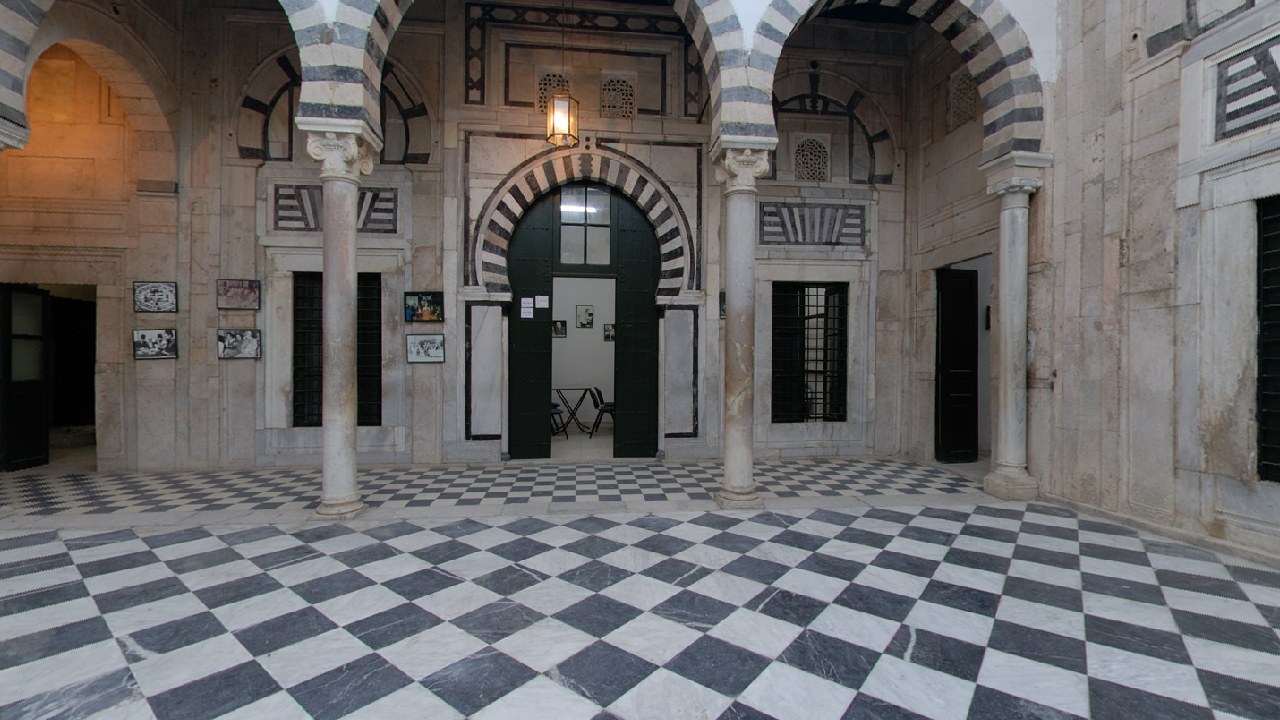
Here, one need only ignore the recent two-coloured chequerboard paving and imagine the pinkish ochre stone of the walls covering the courtyard floor to recover its original elegance. What care in the stonework spread over the walls, enhanced by courses of black and white marble forming the voussoirs of the arches and running in horizontal, oblique or interlaced lines over the lintels of doors and windows!
The main room has a square plan with three trefoil sitting alcoves. This model, called bit diwani, is a sign of the prestige of the master of the house and the importance he gave to the reception space.
A short story: the Daouletli's justice
The upper floor opening onto Sidi Ben Arous, which held the driba (court room) and offices, is built over the vaults of three prisons: for men, for women and for slaves. The Daouletli judged offences and referred crimes to the Bey. Penalties for offences were the bastinado, a fine or prison; for crimes, hard labour or death.
The bastinado was administered by an executioner who had to hold a loaf of bread under his arm during the punishment, so that he could only strike with his forearm and therefore not too hard.
On justice, here is the testimony of E. Pellissier, who travelled the country from 1840: "a long series of observations," he wrote, "has convinced me that infinitely fewer crimes are committed among the Arabs than among any European people". Description de la Régence de Tunis, Tunis, Éditions Bouslama.
Rue de la Driba Dar el Jeld
Tel: +216 71 56 08 44
