Registered monuments
1. Sadiki College
Discoveries
2. Medersa el Bachia
Discoveries
3. Tunis City Hall
Discoveries
4. Municipal Theatre
Discoveries
5. Tourbet el Bey
Discoveries
6. Kasbah Mosque (Almohad Mosque)
Mosques and zawiyas
7. El Ksar Mosque
Mosques and zawiyas
8. Zitouna Mosque
Mosques and zawiyas
9. Hammouda Pacha Mosque
Mosques and zawiyas
10. Sahib el Tabaa Mosque
Mosques and zawiyas
11. Sidi Mehrez Mosque
Mosques and zawiyas
12. Youssef Dey Mosque
Mosques and zawiyas
13. Sidi Kacem Jellizi
Mosques and zawiyas
14. Zaouia Sidi Ali Chiha
Mosques and zawiyas
15. Zaouia Sidi Brahim Riahi
Mosques and zawiyas
16. Zaouia Sidi Mehrez
Mosques and zawiyas
17. Club Tahar Haddad
Palaces and houses
18. Dar Bach Hamba – Cultural Centre for the Mediterranean
Palaces and houses
19. Dar Ben Achour
Palaces and houses
20. Dar Ben Ammar
Palaces and houses
21. Dar Bouderbala – Galerie Médina
Palaces and houses
22. Dar el Haddad
Palaces and houses
23. Dar el Jaziri
Palaces and houses
24. Dar el Jeld – Gastronomy and Tradition
Palaces and houses
25. Dar el Médina
Palaces and houses
26. Dar Hammouda Pacha
Palaces and houses
27. Dar Hussein
Palaces and houses
28. Dar Lasram
Palaces and houses
29. Dar Othman
Palaces and houses
30. Dar Rachidia
Palaces and houses
31. Diwan Dar el Jeld
Palaces and houses
32. El Ali
Palaces and houses
33. Hotel Tunisia Palace
Palaces and houses
34. Calligrapher
Souks and crafts
35. Flag makers
Souks and crafts
36. El Makhzen
Souks and crafts
37. Blacksmith
Souks and crafts
38. The bransi at work
Souks and crafts
39. Diwan Bookshop
Souks and crafts
40. Carpenter
Souks and crafts
41. Souk Chaouachine
Souks and crafts
42. Souk el Attarine
Souks and crafts
43. Souk el Berka
Souks and crafts
44. Souk el Blaghgia
Souks and crafts
45. Souk el Blat
Souks and crafts
46. Souk el Fekka
Souks and crafts
47. Souk en Nhas
Souks and crafts
48. Souk et Trouk
Souks and crafts
Tunisia
History: a great traditional Tunis house In 1820 the inauguration of Dar Lasram did not go unnoticed in Tunis. The work, which lasted seven long years, called on the best master builders ( maalem ). Hardly surprising, since its founder, Hammouda Lasram, was not short of means: commander of the…
360° virtual tour (4 scenes)
Location on the map
Dar Lasram – Headquarters of the Association for the Safeguarding of the Medina of Tunis
History: a great traditional Tunis house
In 1820 the inauguration of Dar Lasram did not go unnoticed in Tunis. The work, which lasted seven long years, called on the best master builders (maalem). Hardly surprising, since its founder, Hammouda Lasram, was not short of means: commander of the Zouaoua infantry corps, he also owned several farms around Tunis.
The palace was occupied by the founder's descendants until it was acquired for the Municipality in 1964. The Municipality installed there the Association for the Safeguarding of the Medina, newly founded under the auspices of a far-sighted mayor.
Restoring the building was more than a one-off operation: it was meant as a model to persuade owners who were leaving their houses to resist the exodus from the historic site and perhaps even begin a return. Today that aim has largely been achieved.
Architecturally, the palace ingeniously distributes over three levels the essential components of a great traditional Tunis house. The ground floor holds the outbuildings, makhzen and service quarters; the upper floor the main residence; and half a level higher, the guest house or ali el dhiaf.
A flight of steps leads to a driba, a reception and circulation space. To the left of the entrance, the access to the ali el dhiaf keeps it independent of the masters' residence.
To the right is the entrance to the bit el sahara (room for men's evening gatherings), followed by the entrance to the sqifas. Between the two doors, a recent counter has been opened to receive the public.
To reach the courtyard one passes through the sqifas, here three in number given the importance of the house. These intermediate spaces isolate the courtyard from the nuisances of the street: prying eyes, noise, heat…
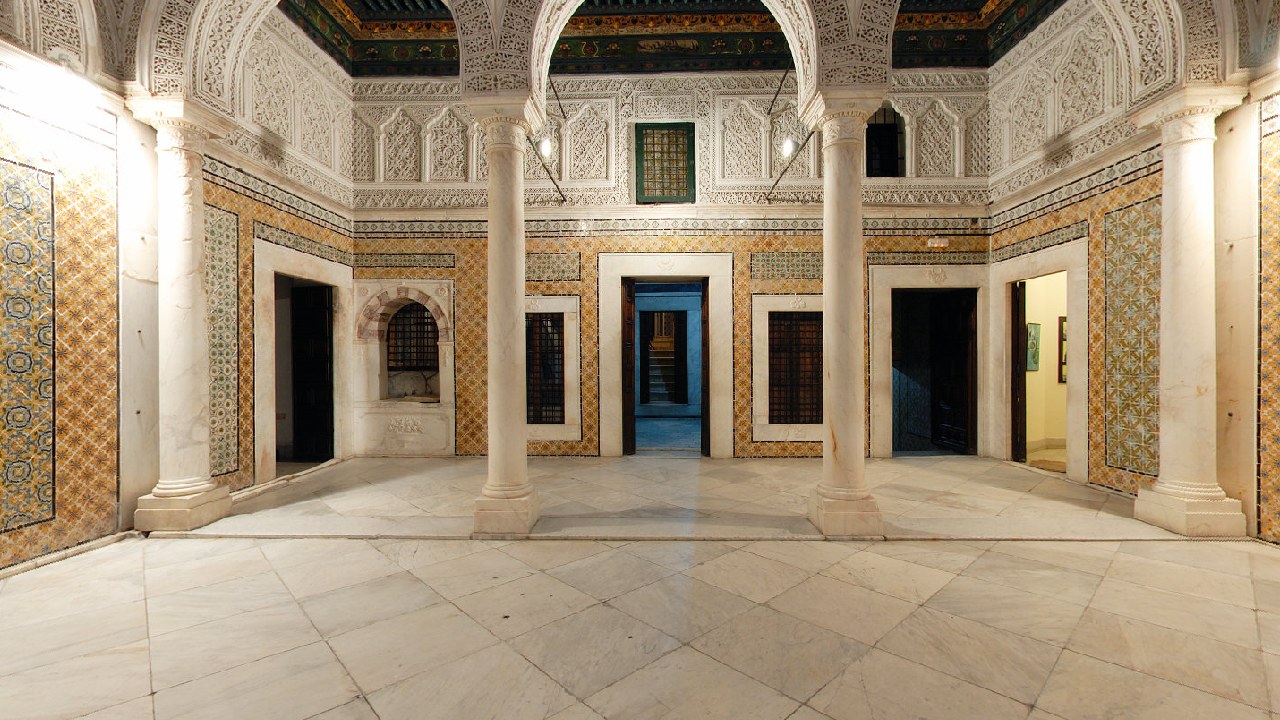
The gleaming marble of the paving and of the door and window frames of the main courtyard sets off the harmonious colours of the wall tiles.
Opposite the entrance, the state room is original for its cruciform plan, made up of three qbou (alcoves) and four small corner rooms. It is lit by four windows, two onto the courtyard and two overlooking the garden. Its decoration reflects the remarkable syncretism of Tunisian art: wall panels of Tunis tiles, a stucco frieze of Andalusian inspiration (arcading with muqarnas), Italian-style painted wooden ceilings.
The guest floor is arranged around a charming small courtyard. The walls are covered with tiles that are quite rare for their size (8 cm square) and their predominant green, blue and yellow on a white ground. The staircase that starts in the driba ends at one corner of the courtyard.
A short story: a corridor of sheets for the ladies' outings
Bourgeois ladies travelled by carriage on their rare outings. We know that the ladies of Dar Lasram reached the makhzen (stables and carriage house) through a connecting door, without going into the street. But do you know how ladies who had to take the carriage in front of the house went out?
Here is the scene as our grandmothers described it: the men put up the draqate, two sheets stretched from the threshold of the house to the steps of the carriage, forming a screen and a passage so that passers-by could not see the women, even though they were veiled.
Women of the people moved about more freely. Their presence in the streets and souks is noted by more than one traveller since the 15th century (Adorne, Leo Africanus…)
24, rue du Tribunal
Tel: +216 71 56 08 96
www.asmtunis.com
