360° virtual tour (4 scenes)
Location on the map
Dar el Jeld – Gastronomy and Tradition
History: a very special atmosphere
When in 1987 the Abdelkefi family decided to open a gourmet restaurant in rue Dar el Jeld, nothing suggested the project would succeed, so marginalised was the Medina at the time. Moreover, the use of the house as a hotel from 1948 had led to damaging alterations: partitions, new openings… It took the talent of the architect Mokhtar Derwich and substantial funding to restore the house's original plan and the brilliance of its decoration.
The sqifas, those often poorly lit passage spaces, have become a warm reception area lit from the street. Their furniture, made by the Ken workshops, draws on tradition and the various woodworking techniques: turned, carved and painted.
The bent passage ends in a cosy lounge facing a counter, separated from it by a carved wooden partition.
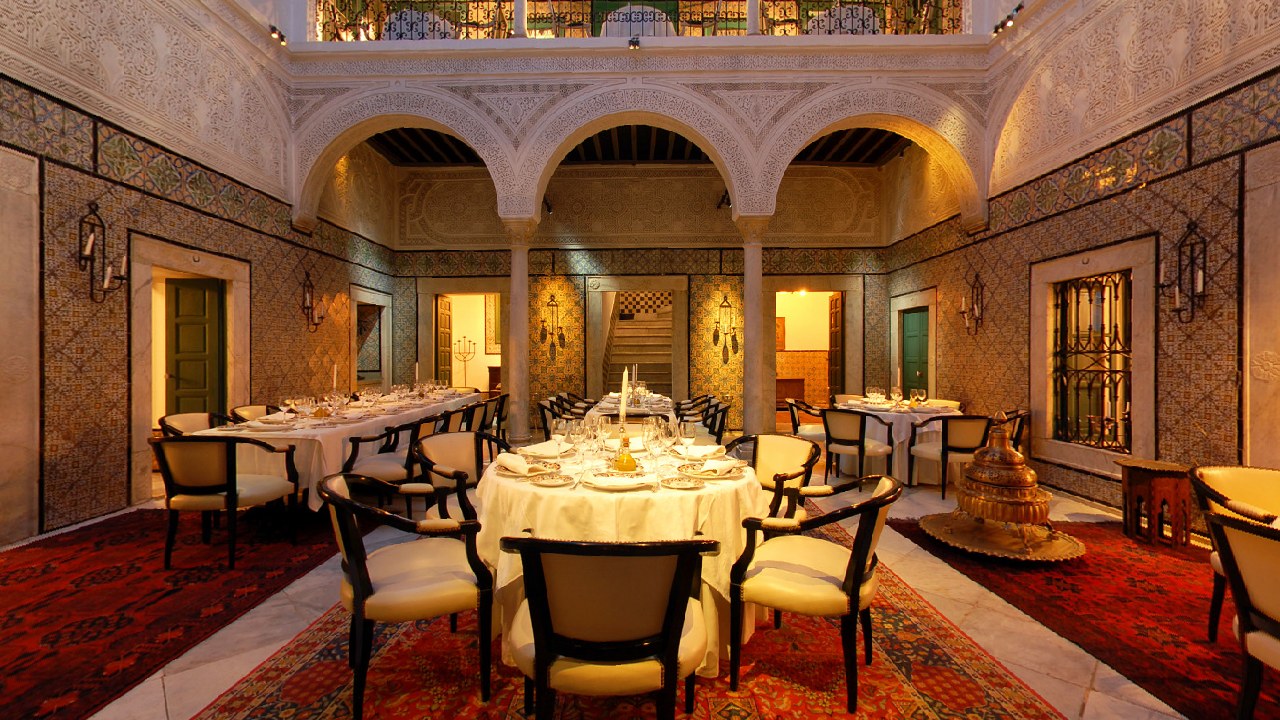
The courtyard, with two facing porticoes, is no different in its decoration from other courtyards: Italian marble, glazed tiles, stucco frieze. Yet a very special atmosphere reigns there. Is it the soft light filtered by the translucent canvas covering the patio? Or the elegance of the tables, where nothing is left to chance, from the luxurious carpets to the fresh flowers constantly renewed?
A short story: leather trafficking
The name Dar el Jeld, or house of leather, recalls the history of the street. Three or four centuries ago it ran along the city wall and was therefore rather out of the way. It is not surprising that Dar el Jeld was located here, where all animal hides, a tax monopoly, were processed. After tanning, the leather was sold inland or exported.
The leather monopoly, like those of tobacco, salt and soap, was farmed out by the government to contractors, the lazam, who paid a lump sum to the State and then recovered their outlay at a profit, which opened the door to every kind of abuse.
To increase their profits, the tax farmers resorted to the most shameless frauds. It is said that the lazam's agents would throw a hide over the wall of a house at night, then turn up at dawn to record the offence and demand a heavy fine. It was almost impossible to obtain justice, since the government tolerated these practices so as not to upset its budget.
64, rue Sidi Ben Arous
Tel: +216 71 56 30 22
www.darelmedina.com
