Registered monuments
1. Sadiki College
Discoveries
2. Medersa el Bachia
Discoveries
3. Tunis City Hall
Discoveries
4. Municipal Theatre
Discoveries
5. Tourbet el Bey
Discoveries
6. Kasbah Mosque (Almohad Mosque)
Mosques and zawiyas
7. El Ksar Mosque
Mosques and zawiyas
8. Zitouna Mosque
Mosques and zawiyas
9. Hammouda Pacha Mosque
Mosques and zawiyas
10. Sahib el Tabaa Mosque
Mosques and zawiyas
11. Sidi Mehrez Mosque
Mosques and zawiyas
12. Youssef Dey Mosque
Mosques and zawiyas
13. Sidi Kacem Jellizi
Mosques and zawiyas
14. Zaouia Sidi Ali Chiha
Mosques and zawiyas
15. Zaouia Sidi Brahim Riahi
Mosques and zawiyas
16. Zaouia Sidi Mehrez
Mosques and zawiyas
17. Club Tahar Haddad
Palaces and houses
18. Dar Bach Hamba – Cultural Centre for the Mediterranean
Palaces and houses
19. Dar Ben Achour
Palaces and houses
20. Dar Ben Ammar
Palaces and houses
21. Dar Bouderbala – Galerie Médina
Palaces and houses
22. Dar el Haddad
Palaces and houses
23. Dar el Jaziri
Palaces and houses
24. Dar el Jeld – Gastronomy and Tradition
Palaces and houses
25. Dar el Médina
Palaces and houses
26. Dar Hammouda Pacha
Palaces and houses
27. Dar Hussein
Palaces and houses
28. Dar Lasram
Palaces and houses
29. Dar Othman
Palaces and houses
30. Dar Rachidia
Palaces and houses
31. Diwan Dar el Jeld
Palaces and houses
32. El Ali
Palaces and houses
33. Hotel Tunisia Palace
Palaces and houses
34. Calligrapher
Souks and crafts
35. Flag makers
Souks and crafts
36. El Makhzen
Souks and crafts
37. Blacksmith
Souks and crafts
38. The bransi at work
Souks and crafts
39. Diwan Bookshop
Souks and crafts
40. Carpenter
Souks and crafts
41. Souk Chaouachine
Souks and crafts
42. Souk el Attarine
Souks and crafts
43. Souk el Berka
Souks and crafts
44. Souk el Blaghgia
Souks and crafts
45. Souk el Blat
Souks and crafts
46. Souk el Fekka
Souks and crafts
47. Souk en Nhas
Souks and crafts
48. Souk et Trouk
Souks and crafts
Tunisia
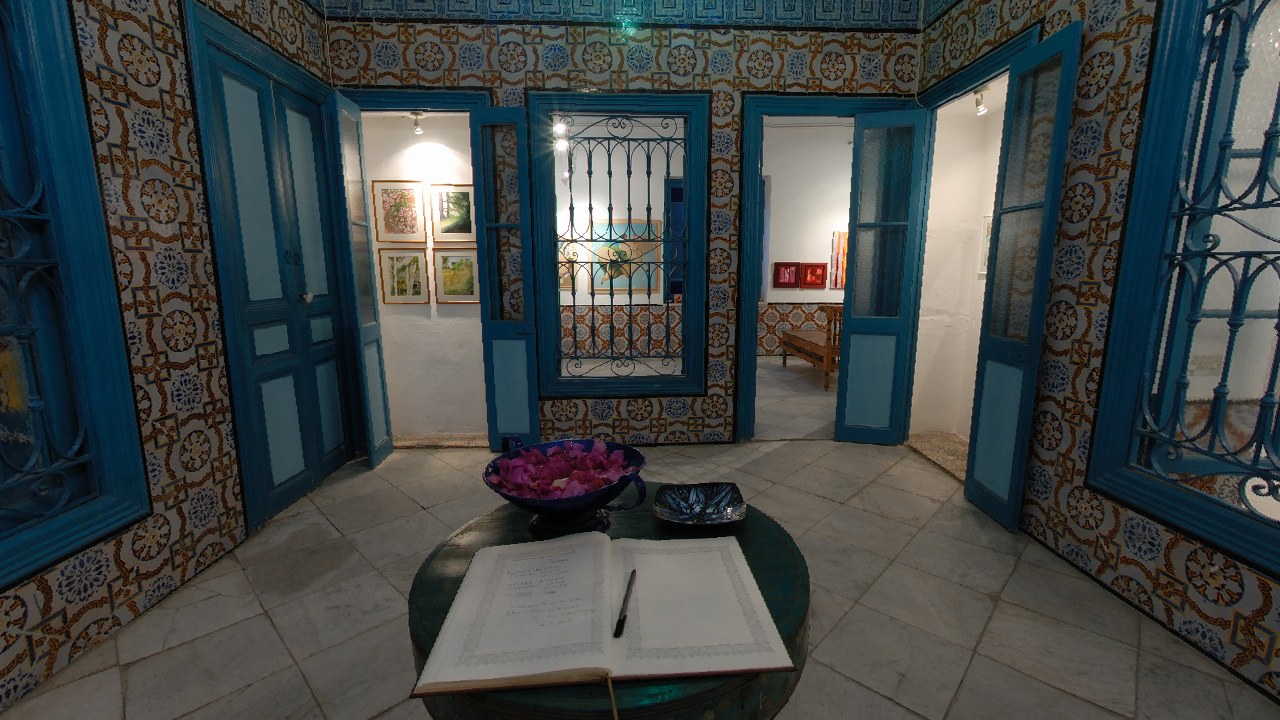
History: The house flooded with light. This is an ali el dhiaf , or guest floor, of a large house laid out on the ground floor and dating from the late 19th century. After being occupied by the Bouderbala family, it was converted into an art gallery in 1984 on the initiative of its owner. This…
360° virtual tour (6 scenes)
Dar Bouderbala – Galerie Médina
History:
The house flooded with light. This is an ali el dhiaf, or guest floor, of a large house laid out on the ground floor and dating from the late 19th century.
After being occupied by the Bouderbala family, it was converted into an art gallery in 1984 on the initiative of its owner. This novelty among the Medina's facilities was hailed by the press as "a gallery unique of its kind, combining the old style of architecture with the modern spirit of an art gallery, without sacrificing one to the other or distorting them".
The house seems predestined for its new function, so intense is the light.
The staircase opens onto a first landing serving a half-level of small rooms whose doors and partitions have been removed to create open exhibition spaces. A large window overlooking the city's rooftops floods the space with light.
A few steps to the left lead to the main courtyard, covered by what master masons call the raqba (the neck): a solution known to the Romans (see the underground houses of Bulla Regia or the reconstructed Maison Africa at El Jem), which lights the courtyard through high windows open on all four sides at ceiling level, giving onto the side terraces. Two pairs of facing arches, finely cut in a rectilinear and curvilinear outline, are as decorative as they are functional; the raqba thus rests on a square plan.
Around the courtyard are the rooms, which receive its light and that of wide openings to the outside, while care is taken to avoid overlooking and to preserve inner privacy.
Since its foundation, the Galerie Médina has constantly organised themed exhibitions, introduced young painters and held retrospectives of great masters.
A short story:
The bathroom. Dar Bouderbala adapted to "Western" comfort by installing a bathroom in the bedroom. Traditionally, water is banished from the place where one sleeps. Do you know why?
Out of superstition about contact with ness lokhra (the others) who live underground: evil, unpredictable beings able to come up through the drains and harm the occupants of the room in their sleep. Today such beliefs are no longer given credit, and the bathroom easily finds its place in the maksoura (alcove) of the T-shaped room.
11, rue Dar El Jeld
Tel: +216 71 56 13 77
