Registered monuments
1. Sadiki College
Discoveries
2. Medersa el Bachia
Discoveries
3. Tunis City Hall
Discoveries
4. Municipal Theatre
Discoveries
5. Tourbet el Bey
Discoveries
6. Kasbah Mosque (Almohad Mosque)
Mosques and zawiyas
7. El Ksar Mosque
Mosques and zawiyas
8. Zitouna Mosque
Mosques and zawiyas
9. Hammouda Pacha Mosque
Mosques and zawiyas
10. Sahib el Tabaa Mosque
Mosques and zawiyas
11. Sidi Mehrez Mosque
Mosques and zawiyas
12. Youssef Dey Mosque
Mosques and zawiyas
13. Sidi Kacem Jellizi
Mosques and zawiyas
14. Zaouia Sidi Ali Chiha
Mosques and zawiyas
15. Zaouia Sidi Brahim Riahi
Mosques and zawiyas
16. Zaouia Sidi Mehrez
Mosques and zawiyas
17. Club Tahar Haddad
Palaces and houses
18. Dar Bach Hamba – Cultural Centre for the Mediterranean
Palaces and houses
19. Dar Ben Achour
Palaces and houses
20. Dar Ben Ammar
Palaces and houses
21. Dar Bouderbala – Galerie Médina
Palaces and houses
22. Dar el Haddad
Palaces and houses
23. Dar el Jaziri
Palaces and houses
24. Dar el Jeld – Gastronomy and Tradition
Palaces and houses
25. Dar el Médina
Palaces and houses
26. Dar Hammouda Pacha
Palaces and houses
27. Dar Hussein
Palaces and houses
28. Dar Lasram
Palaces and houses
29. Dar Othman
Palaces and houses
30. Dar Rachidia
Palaces and houses
31. Diwan Dar el Jeld
Palaces and houses
32. El Ali
Palaces and houses
33. Hotel Tunisia Palace
Palaces and houses
34. Calligrapher
Souks and crafts
35. Flag makers
Souks and crafts
36. El Makhzen
Souks and crafts
37. Blacksmith
Souks and crafts
38. The bransi at work
Souks and crafts
39. Diwan Bookshop
Souks and crafts
40. Carpenter
Souks and crafts
41. Souk Chaouachine
Souks and crafts
42. Souk el Attarine
Souks and crafts
43. Souk el Berka
Souks and crafts
44. Souk el Blaghgia
Souks and crafts
45. Souk el Blat
Souks and crafts
46. Souk el Fekka
Souks and crafts
47. Souk en Nhas
Souks and crafts
48. Souk et Trouk
Souks and crafts
Tunisia
History: Soltan el Medina A zaouia that is never empty, for it holds the tomb of Sidi Mehrez, patron saint of Tunis, proclaimed Soltan el Medina (Sultan of the Medina) by its inhabitants. Mehrez Ibn Khalef was born in the Ariana suburb, where he began a quiet career as a meddeb (tutor). He then…
360° virtual tour (4 scenes)
Location on the map
Zaouia Sidi Mehrez
History: Soltan el Medina
A zaouia that is never empty, for it holds the tomb of Sidi Mehrez, patron saint of Tunis, proclaimed Soltan el Medina (Sultan of the Medina) by its inhabitants.
Mehrez Ibn Khalef was born in the Ariana suburb, where he began a quiet career as a meddeb (tutor). He then moved to Tunis and bought a house near Bab Souika, where he was buried in 1022. Popular belief and the generosity of rulers turned the place into a lavish zaouia.
A pious and virtuous poet, Sidi Mehrez distinguished himself above all by his commitment to the struggle against the Shiite rite, introduced by the Fatimids and imposed as the official religion in a country of Sunni Maliki tradition.
He is also known for his economic role. After Tunis was sacked by the Kharijite Abu Yazid in September 945, it was he who urged the population to rebuild the damaged walls and reorganise trade.
Tradition unanimously credits him with founding the Jewish quarter of the Hara, a short distance from his zaouia, no doubt to keep this active population in the city for the benefit of its economy. Until then, Jews had access to the city by day but had to leave it in the evening for a district near Mellassine where they lived.
To save Tunis, Sidi Mehrez also used his "supernatural" powers. Is he not credited with causing from afar the death of the Zirid emir Ibn Badis?
A host of tents pitched near Sijoumi made the people of Tunis tremble. Their saint reassured them and, from the top of the Kasbah hill, prayed to God that Badis perish and Tunis be protected. The next day the emir was found pierced by his own sword in his silk tent. Out of fear, his successor el Moez issued a dhahir (edict) ordering "the authorities to ensure that no one touches the person of Sidi Mehrez or his property, nor the persons or property of his followers".
His fame, established "for eternity", extended beyond Ifriqiya. In his guide to places of pilgrimage, the geographer El Hawari, who died in Aleppo in 1215, mentions "the sanctuary of Sidi Mehrez, whom sailors invoke when the sea turns rough and to whom they make vows".
People from Tunis and elsewhere still visit the zaouia of Sidi Mehrez to pray, make vows and offerings. When Jews were numerous in the Hara, they too venerated the Soltan el Medina.
The zaouia was considered a refuge offering absolute immunity, even to the most dangerous criminal. Only in 1888, after the reorganisation of justice, was this tradition ended, when a criminal was forcibly removed to be brought before the courts.
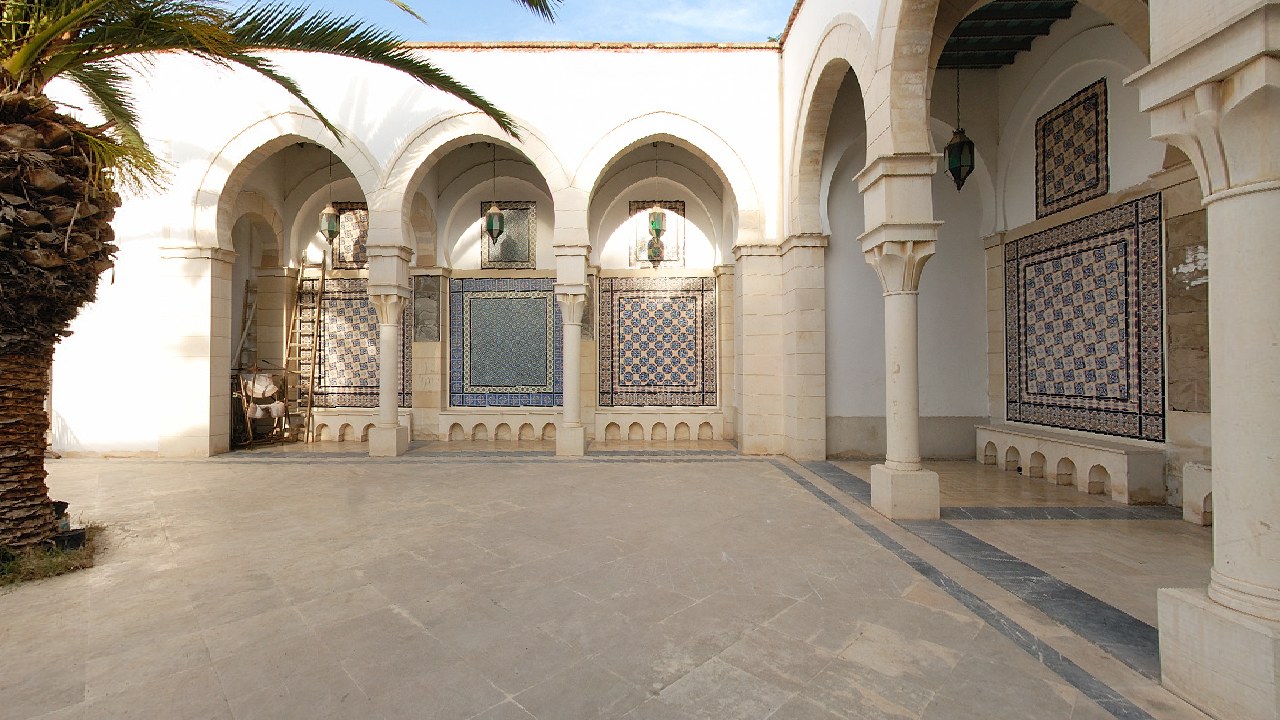
The courtyard, remodelled in the 1980s, precedes a hall covered by a dome on squinches. Here is the well said to be "blessed". The ziara (visit) is not complete without drinking its water. It is customary to bring a little boy on the day of his circumcision and a young woman on the eve of her wedding to drink and wash their face and hands. This cool water brings serenity to face the rite of passage in peace.
The hall and the funerary chamber date from the late 19th century, under Sadok Bey. The latter, more imposing with its ovoid dome, stands out for its carved plaster, where arabesques mingle with the vase-and-bouquet motif.
The two-tiered openwork wooden catafalque is protected by a wrought-iron grille backed by a wooden balustrade.
A short story: Sidi Mehrez's poem on the ruins of Carthage
I saw these walls like a mirage
This pride amid destitution
Let a tear be a tribute!
Why this emptiness after joy?
This bareness after glory?
This nothingness that was a city?
Who will answer? Only the wind
That replaces the priests' chant
And scatters the souls once gathered.
87, rue Sidi Mehrez
