Registered monuments
1. Sadiki College
Discoveries
2. Medersa el Bachia
Discoveries
3. Tunis City Hall
Discoveries
4. Municipal Theatre
Discoveries
5. Tourbet el Bey
Discoveries
6. Kasbah Mosque (Almohad Mosque)
Mosques and zawiyas
7. El Ksar Mosque
Mosques and zawiyas
8. Zitouna Mosque
Mosques and zawiyas
9. Hammouda Pacha Mosque
Mosques and zawiyas
10. Sahib el Tabaa Mosque
Mosques and zawiyas
11. Sidi Mehrez Mosque
Mosques and zawiyas
12. Youssef Dey Mosque
Mosques and zawiyas
13. Sidi Kacem Jellizi
Mosques and zawiyas
14. Zaouia Sidi Ali Chiha
Mosques and zawiyas
15. Zaouia Sidi Brahim Riahi
Mosques and zawiyas
16. Zaouia Sidi Mehrez
Mosques and zawiyas
17. Club Tahar Haddad
Palaces and houses
18. Dar Bach Hamba – Cultural Centre for the Mediterranean
Palaces and houses
19. Dar Ben Achour
Palaces and houses
20. Dar Ben Ammar
Palaces and houses
21. Dar Bouderbala – Galerie Médina
Palaces and houses
22. Dar el Haddad
Palaces and houses
23. Dar el Jaziri
Palaces and houses
24. Dar el Jeld – Gastronomy and Tradition
Palaces and houses
25. Dar el Médina
Palaces and houses
26. Dar Hammouda Pacha
Palaces and houses
27. Dar Hussein
Palaces and houses
28. Dar Lasram
Palaces and houses
29. Dar Othman
Palaces and houses
30. Dar Rachidia
Palaces and houses
31. Diwan Dar el Jeld
Palaces and houses
32. El Ali
Palaces and houses
33. Hotel Tunisia Palace
Palaces and houses
34. Calligrapher
Souks and crafts
35. Flag makers
Souks and crafts
36. El Makhzen
Souks and crafts
37. Blacksmith
Souks and crafts
38. The bransi at work
Souks and crafts
39. Diwan Bookshop
Souks and crafts
40. Carpenter
Souks and crafts
41. Souk Chaouachine
Souks and crafts
42. Souk el Attarine
Souks and crafts
43. Souk el Berka
Souks and crafts
44. Souk el Blaghgia
Souks and crafts
45. Souk el Blat
Souks and crafts
46. Souk el Fekka
Souks and crafts
47. Souk en Nhas
Souks and crafts
48. Souk et Trouk
Souks and crafts
Tunisia
History: the house of a great scholar The zaouia was built in 1854 by Ahmed Bey and completed in 1878 by Sadok Bey, around the tomb of Brahim Riahi, who died in 1850. He was born in Testour in 1766. He joined the Great Mosque and, like every student from outside the city, found lodging in the…
360° virtual tour (5 scenes)
Location on the map
Zaouia Sidi Brahim Riahi
History: the house of a great scholar
The zaouia was built in 1854 by Ahmed Bey and completed in 1878 by Sadok Bey, around the tomb of Brahim Riahi, who died in 1850.
He was born in Testour in 1766. He joined the Great Mosque and, like every student from outside the city, found lodging in the medersa el Achouria and then in the medersa Bir Lahjar, both in the Pacha district, where he would remain in life as in death.
He completed his studies brilliantly and was soon unanimously recognised as a great scholar. A poet steeped in mysticism, he was initiated in Morocco into the Tijaniya tariqa (brotherhood), which he introduced into the Regency. It was to spread the Tijaniya that he laid the foundations of the zaouia.
His spiritual life did not prevent him from holding high office. He was a professor, then grand mufti and first imam of the Great Mosque, and he carried out diplomatic missions to the King of Morocco and the Sultan in Istanbul. He died in August 1850, a few months after his son, both carried off by the plague.
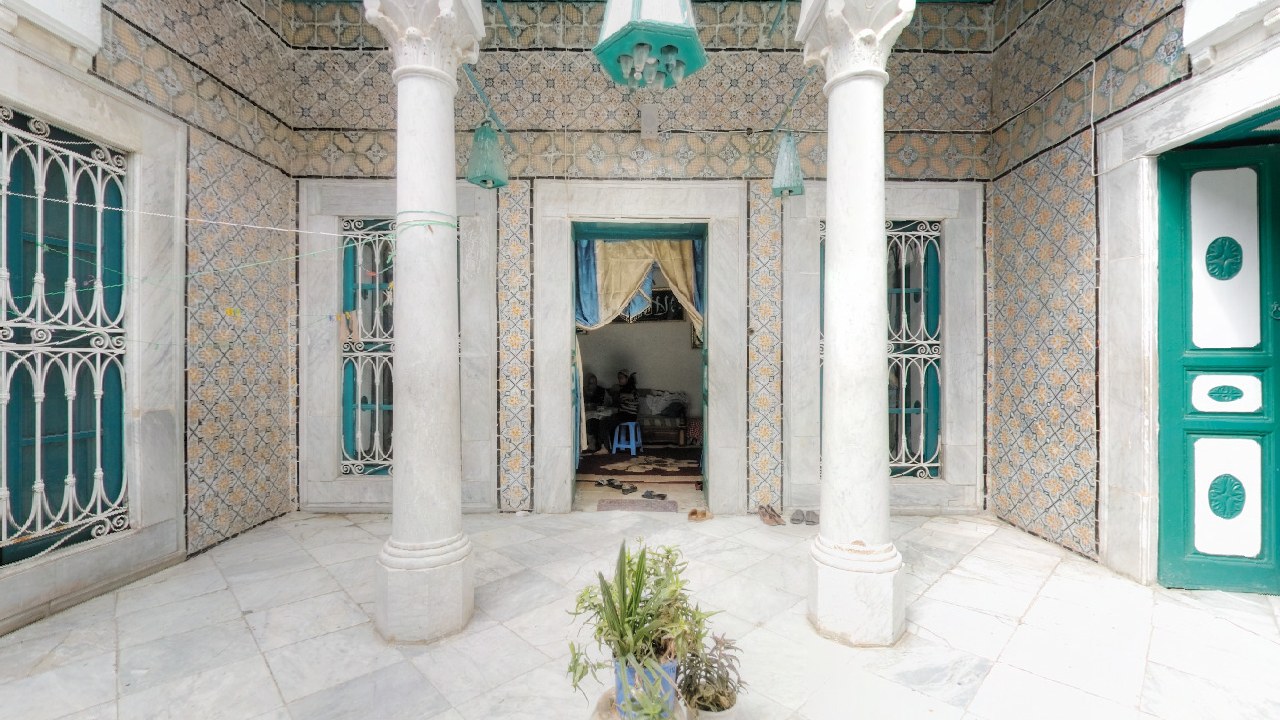
The bent entrance leads to a courtyard entirely in white Carrara marble: paving, door and window frames, columns and volute capitals supporting the arches of the opposite galleries.
The courtyard leads to an ablution room and to rooms for the many visitors who come to pray and make vows.
On the right side, a large domed hall is reserved for the mi'ad (liturgical gatherings) that bring the Tijani together every Friday. The dome on squinches is a jewel of Hispano-Moorish architecture. Master craftsmen (maalem) came specially from Morocco to carry out the carved plaster work.
In the small room opposite the mihrab lies the saint's tomb, topped by a catafalque draped in brightly coloured silk, a gift from followers of the Tijaniya and from some women visitors whose vows were granted.
A short story: the young women's ritual
A young woman slow to marry can hope to see suitors "flock" if she follows a practice still observed at the zaouia of Sidi Brahim: she must wash the floor of the zaouia with plenty of water for seven consecutive weeks.
She chooses a fixed day and arrives with everything needed: brooms, mop and products, which remain at her disposal until the end. The cleaning begins with the thresholds of the rooms, then the courtyard and finally the sqifa.
At the end of the seven sessions, the young woman must offer a kassaa, a large dish of well-garnished couscous shared among the visitors. "It's the rhan (the deposit)," explains the naqiba, the keeper in charge of the premises.
11, rue Sidi Brahim Riahi
