Registered monuments
1. Sadiki College
Discoveries
2. Medersa el Bachia
Discoveries
3. Tunis City Hall
Discoveries
4. Municipal Theatre
Discoveries
5. Tourbet el Bey
Discoveries
6. Kasbah Mosque (Almohad Mosque)
Mosques and zawiyas
7. El Ksar Mosque
Mosques and zawiyas
8. Zitouna Mosque
Mosques and zawiyas
9. Hammouda Pacha Mosque
Mosques and zawiyas
10. Sahib el Tabaa Mosque
Mosques and zawiyas
11. Sidi Mehrez Mosque
Mosques and zawiyas
12. Youssef Dey Mosque
Mosques and zawiyas
13. Sidi Kacem Jellizi
Mosques and zawiyas
14. Zaouia Sidi Ali Chiha
Mosques and zawiyas
15. Zaouia Sidi Brahim Riahi
Mosques and zawiyas
16. Zaouia Sidi Mehrez
Mosques and zawiyas
17. Club Tahar Haddad
Palaces and houses
18. Dar Bach Hamba – Cultural Centre for the Mediterranean
Palaces and houses
19. Dar Ben Achour
Palaces and houses
20. Dar Ben Ammar
Palaces and houses
21. Dar Bouderbala – Galerie Médina
Palaces and houses
22. Dar el Haddad
Palaces and houses
23. Dar el Jaziri
Palaces and houses
24. Dar el Jeld – Gastronomy and Tradition
Palaces and houses
25. Dar el Médina
Palaces and houses
26. Dar Hammouda Pacha
Palaces and houses
27. Dar Hussein
Palaces and houses
28. Dar Lasram
Palaces and houses
29. Dar Othman
Palaces and houses
30. Dar Rachidia
Palaces and houses
31. Diwan Dar el Jeld
Palaces and houses
32. El Ali
Palaces and houses
33. Hotel Tunisia Palace
Palaces and houses
34. Calligrapher
Souks and crafts
35. Flag makers
Souks and crafts
36. El Makhzen
Souks and crafts
37. Blacksmith
Souks and crafts
38. The bransi at work
Souks and crafts
39. Diwan Bookshop
Souks and crafts
40. Carpenter
Souks and crafts
41. Souk Chaouachine
Souks and crafts
42. Souk el Attarine
Souks and crafts
43. Souk el Berka
Souks and crafts
44. Souk el Blaghgia
Souks and crafts
45. Souk el Blat
Souks and crafts
46. Souk el Fekka
Souks and crafts
47. Souk en Nhas
Souks and crafts
48. Souk et Trouk
Souks and crafts
Tunisia
History: the Issaouia brotherhood The zaouia of Sidi Ali Chiha was the largest of the Issaouia brotherhood. It was the mother zaouia of several "branches" built across the country for the followers of this brotherhood, founded in the 16th century by Mohamed Ben Issa, who is buried in Meknes in…
360° virtual tour (4 scenes)
Location on the map
Zaouia Sidi Ali Chiha
History: the Issaouia brotherhood
The zaouia of Sidi Ali Chiha was the largest of the Issaouia brotherhood. It was the mother zaouia of several "branches" built across the country for the followers of this brotherhood, founded in the 16th century by Mohamed Ben Issa, who is buried in Meknes in Morocco, which shows how far brotherhood networks extended across the Maghreb and beyond.
The zaouia Sidi Ali Chiha was built in 1852 on the orders of the minister Mustapha Khaznadar, himself a member of the Issaouia brotherhood. He gave it to the sheikh of the brotherhood, Sidi Ali Chiha, who was buried there in 1854.
After independence, the brotherhoods, accused of collaborating with the colonial regime, saw their activities banned, their habous property confiscated by the State and their premises abandoned. The zaouia Sidi Ali Chiha lost its marble columns and capitals, which were replaced by concrete posts. It was on the verge of ruin when, in the 1980s, the historic monuments service decided to restore it and install the Centre for Arabic Calligraphy there.
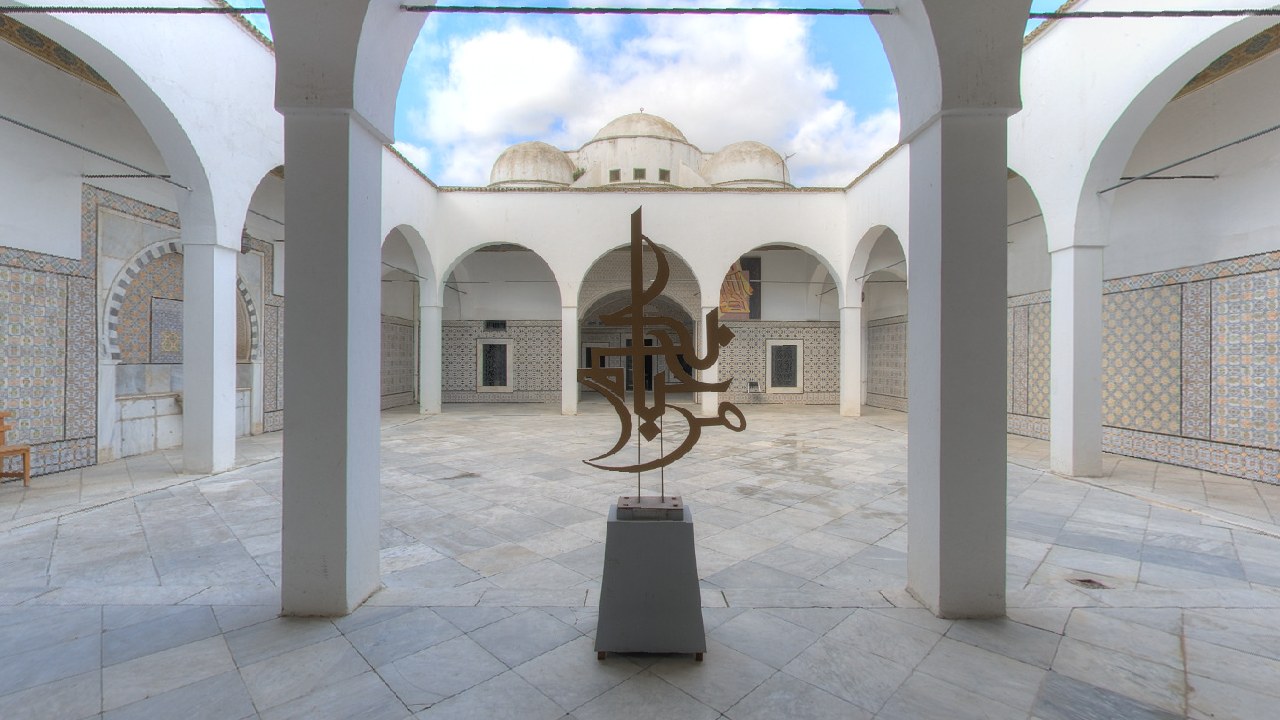
Opposite the entrance, visitors are welcomed by a fine calligraphic composition in copper.
The architectural interest of the monument lies in the great hall and the covered porch in front of it. The porch is covered by a flattened dome decorated with an intricate interlacing of stars in naqch hadida. The hall is covered by an imposing ovoid dome, completed by four domes on the sides.
Behind the wooden partition lies the tomb of Sidi Ali Chiha and his family.
A short story: the miracle of Sidi Chiha
Hagiographic accounts of the lives of saints attribute karamet (miracles) to them.
It is said of Sidi Chiha that one day, while the monument was being built, he asked the masons to follow him through the streets of the district. Reaching a certain spot, he stopped, struck the ground with his stick and ordered them to dig. After a while the workers unearthed two gigantic stone columns. He had them carried to the site and ordered them to be used as supports for the great dome, where they can still be seen!
Rue du Salut
