Registered monuments
1. Sadiki College
Discoveries
2. Medersa el Bachia
Discoveries
3. Tunis City Hall
Discoveries
4. Municipal Theatre
Discoveries
5. Tourbet el Bey
Discoveries
6. Kasbah Mosque (Almohad Mosque)
Mosques and zawiyas
7. El Ksar Mosque
Mosques and zawiyas
8. Zitouna Mosque
Mosques and zawiyas
9. Hammouda Pacha Mosque
Mosques and zawiyas
10. Sahib el Tabaa Mosque
Mosques and zawiyas
11. Sidi Mehrez Mosque
Mosques and zawiyas
12. Youssef Dey Mosque
Mosques and zawiyas
13. Sidi Kacem Jellizi
Mosques and zawiyas
14. Zaouia Sidi Ali Chiha
Mosques and zawiyas
15. Zaouia Sidi Brahim Riahi
Mosques and zawiyas
16. Zaouia Sidi Mehrez
Mosques and zawiyas
17. Club Tahar Haddad
Palaces and houses
18. Dar Bach Hamba – Cultural Centre for the Mediterranean
Palaces and houses
19. Dar Ben Achour
Palaces and houses
20. Dar Ben Ammar
Palaces and houses
21. Dar Bouderbala – Galerie Médina
Palaces and houses
22. Dar el Haddad
Palaces and houses
23. Dar el Jaziri
Palaces and houses
24. Dar el Jeld – Gastronomy and Tradition
Palaces and houses
25. Dar el Médina
Palaces and houses
26. Dar Hammouda Pacha
Palaces and houses
27. Dar Hussein
Palaces and houses
28. Dar Lasram
Palaces and houses
29. Dar Othman
Palaces and houses
30. Dar Rachidia
Palaces and houses
31. Diwan Dar el Jeld
Palaces and houses
32. El Ali
Palaces and houses
33. Hotel Tunisia Palace
Palaces and houses
34. Calligrapher
Souks and crafts
35. Flag makers
Souks and crafts
36. El Makhzen
Souks and crafts
37. Blacksmith
Souks and crafts
38. The bransi at work
Souks and crafts
39. Diwan Bookshop
Souks and crafts
40. Carpenter
Souks and crafts
41. Souk Chaouachine
Souks and crafts
42. Souk el Attarine
Souks and crafts
43. Souk el Berka
Souks and crafts
44. Souk el Blaghgia
Souks and crafts
45. Souk el Blat
Souks and crafts
46. Souk el Fekka
Souks and crafts
47. Souk en Nhas
Souks and crafts
48. Souk et Trouk
Souks and crafts
Tunisia
History: the first Hanafi mosque Some forty years after the Turks settled in the country (1574), after a period of administrative reorganisation and thanks to the wealth accumulated through privateering, Youssef Dey gave Tunis its first Hanafi mosque in 1615. It is a raised mosque, which allowed a…
360° virtual tour (6 scenes)
Location on the map
Youssef Dey Mosque
History: the first Hanafi mosque
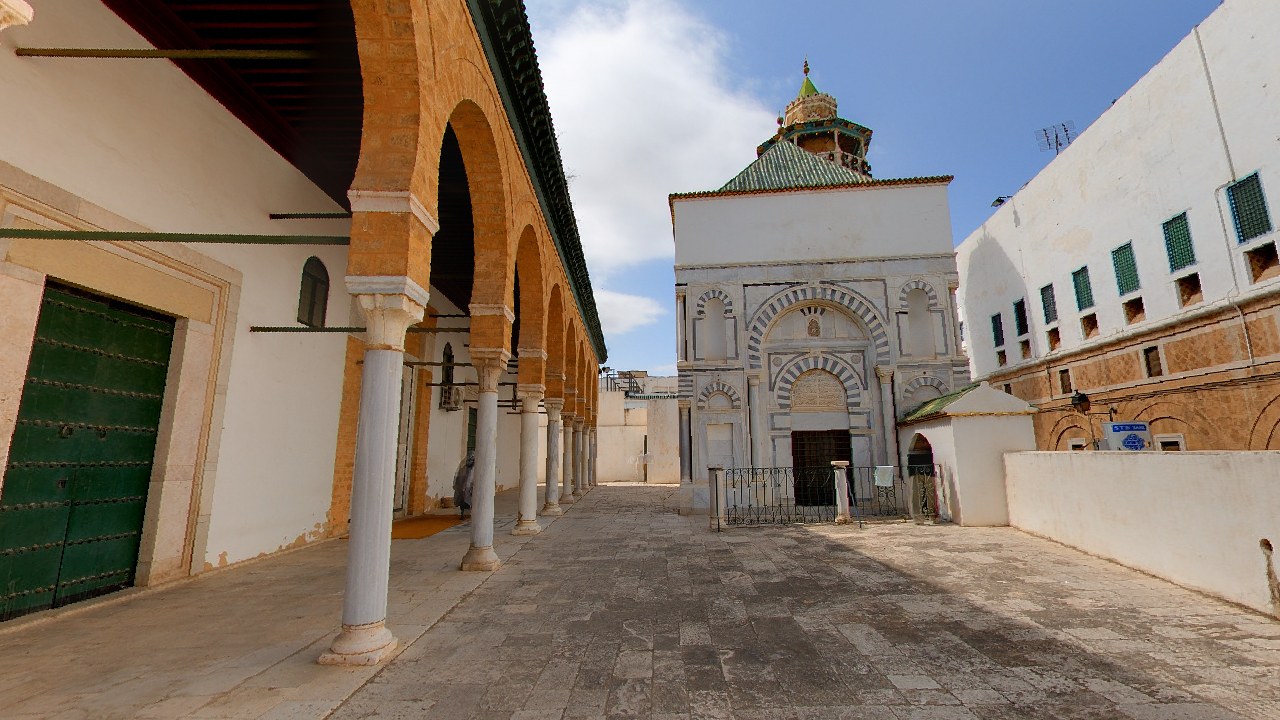
Some forty years after the Turks settled in the country (1574), after a period of administrative reorganisation and thanks to the wealth accumulated through privateering, Youssef Dey gave Tunis its first Hanafi mosque in 1615.
It is a raised mosque, which allowed a row of shops to be built on the ground floor (the former souk of the bchamkia, makers of bichmak, Turkish-style slippers). The income from the shops was made habous for the benefit of the mosque, financing its upkeep.
The minaret rises on a square base and was the first octagonal tower in Tunis; it inspired all the minarets of later Turkish mosques. It ends in a circular balcony from which the muezzins, sheltered by a wooden canopy, called to prayer. A lantern with a pyramidal roof covered in green tiles crowns the whole.
The tourbet, which houses the tomb of Youssef Dey and those of his family, is rightly considered a masterpiece of 17th-century architecture. From outside, each face presents a large central arch flanked by two tiers of niches. The corner columns on both levels lighten this cube of black and white marble with its green pyramidal roof. The interior is no less rich: marble façades in two-coloured courses beneath a Moorish-style coffered wooden ceiling.
A short story: two rites, two kinds of places of worship
The arrival of the Turks, of the Hanafi rite, in a country where the Maliki rite was dominant, if not exclusive, had consequences for the life of the city. Places of worship and teaching were organised according to their affiliation to one rite or the other.
Before the founding of the Youssef Dey Mosque, just after the Ottoman conquest, the Kasbah mosque was assigned to prayer according to the Hanafi rite, natural enough for a mosque at the very seat of power. But the number of followers of this rite grew through births, new arrivals and conversions of renegades, and they needed a new mosque. It is said that the Turkish government cast an eye on the Zitouna Mosque, but neither the Maliki scholars nor public opinion would have accepted such a "spoliation". The idea was dropped almost as soon as it was voiced, and instead the Ksar oratory was turned into a Friday mosque for the Hanafis until the Youssef Dey Mosque was inaugurated.
Rue Sidi Ben Ziad
