Registered monuments
1. Sadiki College
Discoveries
2. Medersa el Bachia
Discoveries
3. Tunis City Hall
Discoveries
4. Municipal Theatre
Discoveries
5. Tourbet el Bey
Discoveries
6. Kasbah Mosque (Almohad Mosque)
Mosques and zawiyas
7. El Ksar Mosque
Mosques and zawiyas
8. Zitouna Mosque
Mosques and zawiyas
9. Hammouda Pacha Mosque
Mosques and zawiyas
10. Sahib el Tabaa Mosque
Mosques and zawiyas
11. Sidi Mehrez Mosque
Mosques and zawiyas
12. Youssef Dey Mosque
Mosques and zawiyas
13. Sidi Kacem Jellizi
Mosques and zawiyas
14. Zaouia Sidi Ali Chiha
Mosques and zawiyas
15. Zaouia Sidi Brahim Riahi
Mosques and zawiyas
16. Zaouia Sidi Mehrez
Mosques and zawiyas
17. Club Tahar Haddad
Palaces and houses
18. Dar Bach Hamba – Cultural Centre for the Mediterranean
Palaces and houses
19. Dar Ben Achour
Palaces and houses
20. Dar Ben Ammar
Palaces and houses
21. Dar Bouderbala – Galerie Médina
Palaces and houses
22. Dar el Haddad
Palaces and houses
23. Dar el Jaziri
Palaces and houses
24. Dar el Jeld – Gastronomy and Tradition
Palaces and houses
25. Dar el Médina
Palaces and houses
26. Dar Hammouda Pacha
Palaces and houses
27. Dar Hussein
Palaces and houses
28. Dar Lasram
Palaces and houses
29. Dar Othman
Palaces and houses
30. Dar Rachidia
Palaces and houses
31. Diwan Dar el Jeld
Palaces and houses
32. El Ali
Palaces and houses
33. Hotel Tunisia Palace
Palaces and houses
34. Calligrapher
Souks and crafts
35. Flag makers
Souks and crafts
36. El Makhzen
Souks and crafts
37. Blacksmith
Souks and crafts
38. The bransi at work
Souks and crafts
39. Diwan Bookshop
Souks and crafts
40. Carpenter
Souks and crafts
41. Souk Chaouachine
Souks and crafts
42. Souk el Attarine
Souks and crafts
43. Souk el Berka
Souks and crafts
44. Souk el Blaghgia
Souks and crafts
45. Souk el Blat
Souks and crafts
46. Souk el Fekka
Souks and crafts
47. Souk en Nhas
Souks and crafts
48. Souk et Trouk
Souks and crafts
Tunisia
History: the emblem of Tunis The M'Hammed Bey Mosque is better known as the Sidi Mehrez Mosque, after the zaouia opposite it. Begun by M'Hammed Bey in 1692 and continued by his brother Romdhane Bey, the work remained unfinished. The programme, inspired by earlier Muradid mosques (those of Youssef…
360° virtual tour (4 scenes)
Location on the map
Sidi Mehrez Mosque
History: the emblem of Tunis
The M'Hammed Bey Mosque is better known as the Sidi Mehrez Mosque, after the zaouia opposite it.
Begun by M'Hammed Bey in 1692 and continued by his brother Romdhane Bey, the work remained unfinished. The programme, inspired by earlier Muradid mosques (those of Youssef Dey and Hammouda Pacha), included an octagonal minaret at the north-west corner of the courtyard and two family tourbets. The death of M'Hammed Bey, the assassination of Romdhane Bey and the unrest under Mourad III prevented its completion.
The mosque is modelled on the Sultan Ahmed Mosque in Istanbul, itself derived from Hagia Sophia.
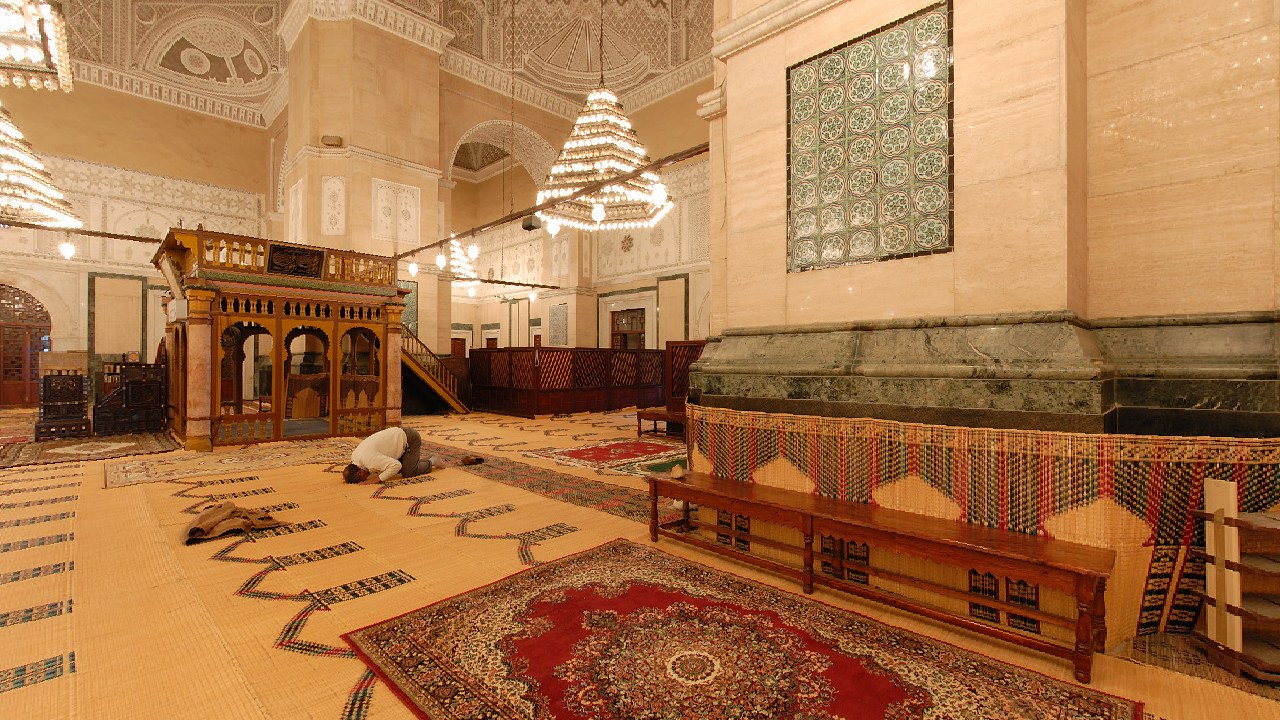
The square prayer hall is surrounded on three sides by galleries and courtyards. Inside, four large pillars support a hemispherical dome rising 29 metres above the floor, buttressed on the sides by four half-domes. At the corners, small domes complete this group of whitewashed domes overlooking the city, an image so emblematic that the City Hall made it the centre of its coat of arms.
A short story: the far-sighted master mason
The first dome of this scale, and the halt in the work after the death of M'Hammed Bey, gave rise to an anecdote that the people of Tunis readily tell as historical fact.
As the domes rose one above the other, the people of Tunis commented on this feat. One morning, news spread like wildfire through the city that the master mason in charge of the work had disappeared. The Bey, informed of the matter, sent his agents to look for him, without success.
A year later the master mason reappeared and asked for an audience with the Bey. "Sidna (our Lord)," he said, "I place myself in your hands and accept whatever punishment you wish to inflict on me, but first allow me to explain the reasons for my absence.
This is the first time I have built such an imposing dome and, despite all my calculations and precautions, I was gnawed by doubt and dread that the work might collapse on the heads of the faithful, to the point that I could no longer sleep at night. So I decided to halt the work to prevent the inauguration of the sanctuary and give time for any settling of the ground. Today I can assure you, O Sidna, that this roof is sound. If you so order, I undertake to finish my work. If you judge otherwise, my head is in your hands."
The Bey appreciated the master mason's initiative; he received a handsome reward and the order to complete the mosque.
87, rue Sidi Mehrez
