Registered monuments
1. Sadiki College
Discoveries
2. Medersa el Bachia
Discoveries
3. Tunis City Hall
Discoveries
4. Municipal Theatre
Discoveries
5. Tourbet el Bey
Discoveries
6. Kasbah Mosque (Almohad Mosque)
Mosques and zawiyas
7. El Ksar Mosque
Mosques and zawiyas
8. Zitouna Mosque
Mosques and zawiyas
9. Hammouda Pacha Mosque
Mosques and zawiyas
10. Sahib el Tabaa Mosque
Mosques and zawiyas
11. Sidi Mehrez Mosque
Mosques and zawiyas
12. Youssef Dey Mosque
Mosques and zawiyas
13. Sidi Kacem Jellizi
Mosques and zawiyas
14. Zaouia Sidi Ali Chiha
Mosques and zawiyas
15. Zaouia Sidi Brahim Riahi
Mosques and zawiyas
16. Zaouia Sidi Mehrez
Mosques and zawiyas
17. Club Tahar Haddad
Palaces and houses
18. Dar Bach Hamba – Cultural Centre for the Mediterranean
Palaces and houses
19. Dar Ben Achour
Palaces and houses
20. Dar Ben Ammar
Palaces and houses
21. Dar Bouderbala – Galerie Médina
Palaces and houses
22. Dar el Haddad
Palaces and houses
23. Dar el Jaziri
Palaces and houses
24. Dar el Jeld – Gastronomy and Tradition
Palaces and houses
25. Dar el Médina
Palaces and houses
26. Dar Hammouda Pacha
Palaces and houses
27. Dar Hussein
Palaces and houses
28. Dar Lasram
Palaces and houses
29. Dar Othman
Palaces and houses
30. Dar Rachidia
Palaces and houses
31. Diwan Dar el Jeld
Palaces and houses
32. El Ali
Palaces and houses
33. Hotel Tunisia Palace
Palaces and houses
34. Calligrapher
Souks and crafts
35. Flag makers
Souks and crafts
36. El Makhzen
Souks and crafts
37. Blacksmith
Souks and crafts
38. The bransi at work
Souks and crafts
39. Diwan Bookshop
Souks and crafts
40. Carpenter
Souks and crafts
41. Souk Chaouachine
Souks and crafts
42. Souk el Attarine
Souks and crafts
43. Souk el Berka
Souks and crafts
44. Souk el Blaghgia
Souks and crafts
45. Souk el Blat
Souks and crafts
46. Souk el Fekka
Souks and crafts
47. Souk en Nhas
Souks and crafts
48. Souk et Trouk
Souks and crafts
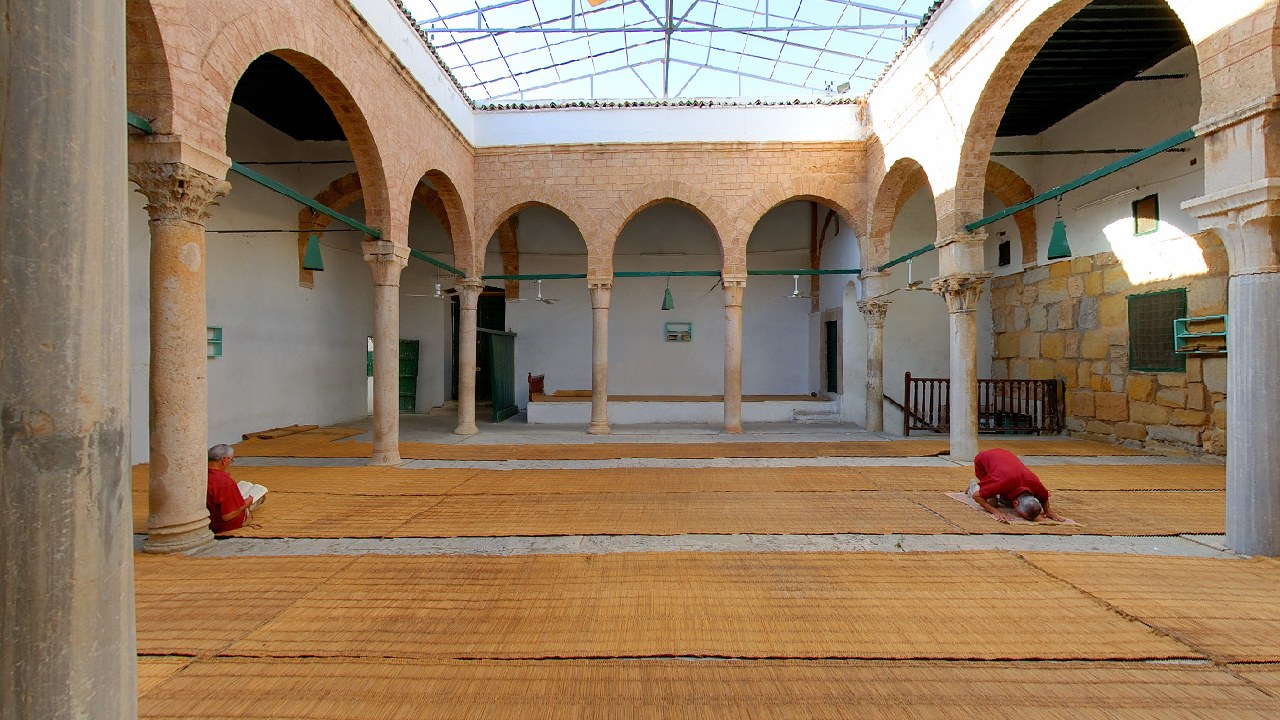
Tunisia
History: a mosque from another time The Ksar (castle), of which this mosque was a dependency, was the official residence of the rulers of the Beni Khorassan dynasty (1063-1156). It stood on the site of today's Dar Hussein. The whole, palace and mosque, may date back to Emir Ahmed Ibn Khorassan…
360° virtual tour (5 scenes)
Location on the map
El Ksar Mosque
History: a mosque from another time
The Ksar (castle), of which this mosque was a dependency, was the official residence of the rulers of the Beni Khorassan dynasty (1063-1156). It stood on the site of today's Dar Hussein. The whole, palace and mosque, may date back to Emir Ahmed Ibn Khorassan (1100-1128), known as a great builder.
A persistent tradition holds that it is an ancient church converted into a mosque. This hypothesis is supported by the absence, in the historical sources, of the name of the sanctuary's founder, whereas such a work would surely have been attributed to a benefactor or claimed by its author.
The shallow mihrab was not designed as such; it is a simple niche hollowed out of the thickness of the wall.
Other arguments put forward are the width of the walls (2.5 metres) and the presence here and there of stones bearing Latin inscriptions. The monument certainly has an undeniably archaic character: it lies well below street level, and its ancient columns and capitals are reused.
Around 1598, when the Turks decided to use it for prayer according to the Hanafi rite, it underwent major restoration and a side courtyard was added, clearly raised above the level of the prayer hall and surrounded by porticoes with Turkish columns and capitals.
In 1622 the mosque was given a minaret unique of its kind: without a base, it rises directly from the walls of the oratory, so thick and sturdy are they.
A short story: the delights of Tunis in the time of the Beni Khorassan
In the 11th century Tunis became the capital of the principality of the Beni Khorassan. It was a time of nomadic invasions (the Beni Hilal and the Beni Suleim) and of raids by the Normans of Sicily.
Amid these dangers, the masters of Tunis found peace by agreeing to pay tribute to the former and concluding trade agreements with the latter.
Their principality prospered; here is what Obeid Allah el Bekri tells us about the delights of Tunis: "There is above all an almond called ferik (crumbly) because its shell is so thin it can be crushed by hand… There is also the tender pomegranate whose seeds have no pips, a juicy fruit with a perfect scent; the large lemon, delicious in taste, pleasant in smell and attractive in appearance; the fig called el kharami, black, large, thin-skinned and full of honeyed juice; the quince, unequalled in size, sweetness and fragrance…
Fish is very plentiful in Tunis, and several species unknown elsewhere are found there; each frequents the sea of Tunis in turn for one month of the year, then disappears completely until the same month the following year. This change allows the pleasures of taste to be enjoyed without interruption and without satiety."
1, rue du Château
