Registered monuments
1. Sadiki College
Discoveries
2. Medersa el Bachia
Discoveries
3. Tunis City Hall
Discoveries
4. Municipal Theatre
Discoveries
5. Tourbet el Bey
Discoveries
6. Kasbah Mosque (Almohad Mosque)
Mosques and zawiyas
7. El Ksar Mosque
Mosques and zawiyas
8. Zitouna Mosque
Mosques and zawiyas
9. Hammouda Pacha Mosque
Mosques and zawiyas
10. Sahib el Tabaa Mosque
Mosques and zawiyas
11. Sidi Mehrez Mosque
Mosques and zawiyas
12. Youssef Dey Mosque
Mosques and zawiyas
13. Sidi Kacem Jellizi
Mosques and zawiyas
14. Zaouia Sidi Ali Chiha
Mosques and zawiyas
15. Zaouia Sidi Brahim Riahi
Mosques and zawiyas
16. Zaouia Sidi Mehrez
Mosques and zawiyas
17. Club Tahar Haddad
Palaces and houses
18. Dar Bach Hamba – Cultural Centre for the Mediterranean
Palaces and houses
19. Dar Ben Achour
Palaces and houses
20. Dar Ben Ammar
Palaces and houses
21. Dar Bouderbala – Galerie Médina
Palaces and houses
22. Dar el Haddad
Palaces and houses
23. Dar el Jaziri
Palaces and houses
24. Dar el Jeld – Gastronomy and Tradition
Palaces and houses
25. Dar el Médina
Palaces and houses
26. Dar Hammouda Pacha
Palaces and houses
27. Dar Hussein
Palaces and houses
28. Dar Lasram
Palaces and houses
29. Dar Othman
Palaces and houses
30. Dar Rachidia
Palaces and houses
31. Diwan Dar el Jeld
Palaces and houses
32. El Ali
Palaces and houses
33. Hotel Tunisia Palace
Palaces and houses
34. Calligrapher
Souks and crafts
35. Flag makers
Souks and crafts
36. El Makhzen
Souks and crafts
37. Blacksmith
Souks and crafts
38. The bransi at work
Souks and crafts
39. Diwan Bookshop
Souks and crafts
40. Carpenter
Souks and crafts
41. Souk Chaouachine
Souks and crafts
42. Souk el Attarine
Souks and crafts
43. Souk el Berka
Souks and crafts
44. Souk el Blaghgia
Souks and crafts
45. Souk el Blat
Souks and crafts
46. Souk el Fekka
Souks and crafts
47. Souk en Nhas
Souks and crafts
48. Souk et Trouk
Souks and crafts
Tunisia
History: from medersa to school The medersa el Bachia dates from 1752, as attested by the inscription above the entrance door. It bears the name of its founder, Prince Ali Pacha, and stands at the end of the booksellers' souk that links it to the Zitouna. The straight entrance with stone side…
360° virtual tour (3 scenes)
Location on the map
Medersa el Bachia
History: from medersa to school
The medersa el Bachia dates from 1752, as attested by the inscription above the entrance door. It bears the name of its founder, Prince Ali Pacha, and stands at the end of the booksellers' souk that links it to the Zitouna.
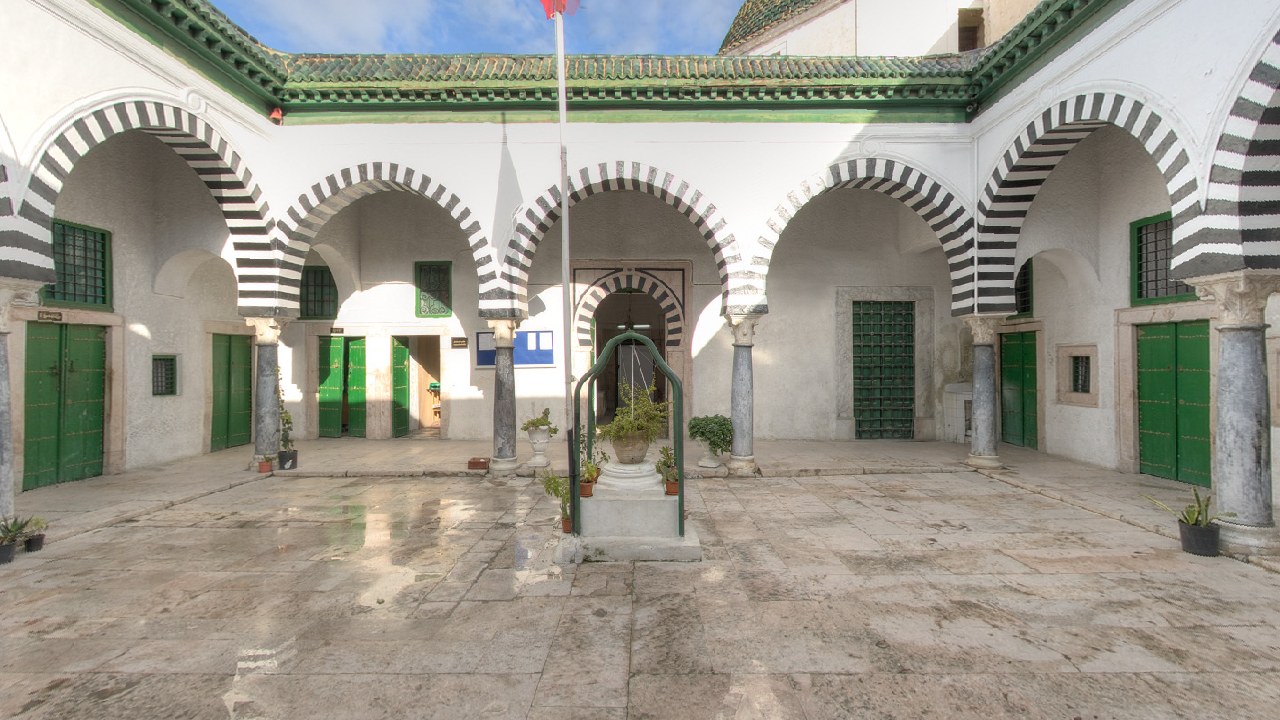
The straight entrance with stone side benches leads to a spacious courtyard with a row of three arches on each side, carried on shaped black marble columns with white marble capitals. In the shade of the galleries, the doors of the former students' rooms line three sides; the fourth side is occupied by the masjed (mosque).
Today the medersa houses a school of crafts whose leather, jewellery and embroidery workshops occupy the former cells as well as the former masjed, divided by wooden partitions.
A short story: the waqfia, the rules governing the medersa
The funding of a medersa, or of any other religious or civil facility, was provided by habous or waqf: inalienable mortmain property whose income is assigned, according to the donor's wishes, to a specific and irrevocable purpose recorded in a written deed, the waqfia. The deed of the medersa el Bachia, drawn up in 1752, is a true charter, full of delightful details, summarised here:
The medersa has thirteen rooms reserved for thirteen students of the Hanafi rite, whether from Tunis or elsewhere.
Students may not spend the night away. They must also attend the three daily lessons given at the medersa. They must be unmarried; if they marry, they automatically lose their right to lodging.
For travel, the statute provides for two cases. A journey for personal reasons allows an absence of no more than two months. If the student makes the pilgrimage to Mecca, the authorised absence is one year. During the absence, the student loses the daily allowance paid to him; the room and the allowance then go to his replacement. On his return, he recovers all his rights.
Besides these resident students, the medersa may admit ten non-resident students allowed to attend the lessons.
The professor assigned to the medersa also has rights and duties. He receives a daily salary and an official residence in the neighbourhood. He must teach three subjects, defined by the habous deed, in three sessions a day, and must lead the five daily prayers in the medersa's masjed.
The deed lists 46 properties whose income pays the professor's salary and the students' allowances, but also the upkeep of the building and the supply of everything the institution needs, such as blankets, mats, lamp oil, ink…
19, rue des Libraires
