Kuwait
 Qatar
Qatar
 Saudi Arabia
 Palestine
Palestine
Palestine
 Oman
Oman
 Syria
Syria
 Tunisia
Palestine
Tunisia
Palestine
 United Arab Emirates
 Yemen
Yemen
 Libya
Saudi Arabia
Libya
Saudi Arabia
 Morocco
 Algeria
 Egypt
Egypt
 Iraq
Iraq
 Mauritania
Qatar
Oman
Oman
Oman
Mauritania
Qatar
Oman
Oman
Oman
 Jordan
Qatar
Iraq
Jordan
Qatar
Iraq
 Lebanon
Saudi Arabia
Saudi Arabia
Saudi Arabia
Lebanon
Saudi Arabia
Saudi Arabia
Saudi Arabia
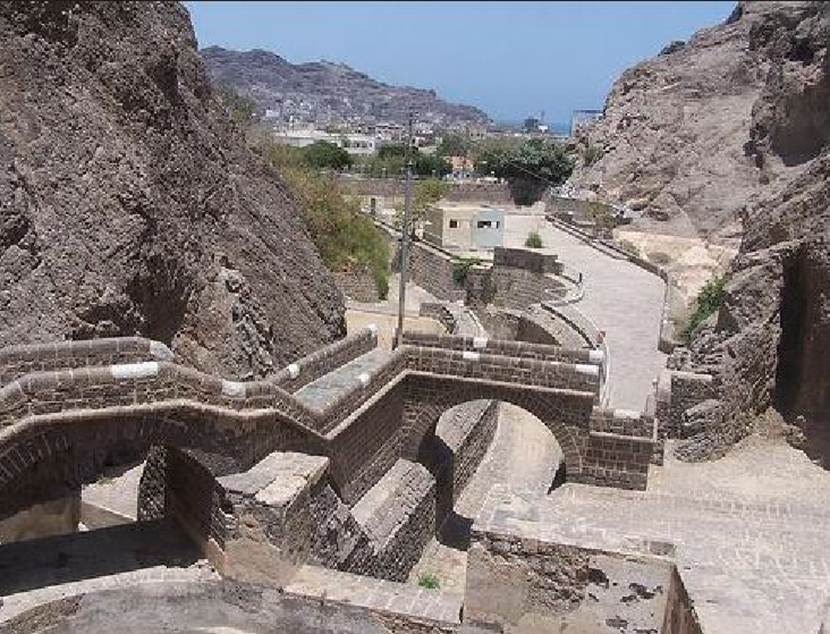
The Cisterns of Aden are one of the most important landmarks of the city of Aden, reflecting the expertise of the Yemeni people since the earliest times in creating a skilful hydraulic and technological system, to control the water of the torrential floods and reduce their hazards by building cisterns (reservoirs) that calm the speed of the rushing water and collect it, and then make use of it and distribute it through a network of channels to reach the places of their use, yet the current cisterns have undergone much modification and additions, and their task of preserving water and protecting the city from the dangers of floods remains to this day.
Their history is closely linked to the history of the city of Aden, for their existence is necessary by virtue of the location of the city and its geography; as there were no fixed sources of water in the city of Aden, which was known as an important port in the ancient world, except these cisterns which were built in stages and different periods of time, owing to the succession of kingdoms and statelets in the rule of this city whose roots run deep in the depth of Yemeni history; the oldest of them dates back to the middle of the second millennium BC, that is about three thousand five hundred years ago.
The network of the Cisterns of Aden reflects a skilful hydraulic and technological system and a unique civilizational aspect, as the network of cisterns performs three tasks at once, which are:
1- a means of catching the water through barrier walls either carved into the rocks of the mountains or built with stones and qadad plaster.
2- retaining the stones and silt that fall with the water cascades.
3- collecting and storing water in large cisterns in the middle of the valley, and then discharging it to where it is needed through a network of passages and water channels.