Kuwait
 Qatar
Qatar
 Saudi Arabia
 Palestine
Palestine
Palestine
 Oman
Oman
 Syria
Syria
 Tunisia
Palestine
Tunisia
Palestine
 United Arab Emirates
 Yemen
Yemen
 Libya
Saudi Arabia
Libya
Saudi Arabia
 Morocco
 Algeria
 Egypt
Egypt
 Iraq
Iraq
 Mauritania
Qatar
Oman
Oman
Oman
Mauritania
Qatar
Oman
Oman
Oman
 Jordan
Qatar
Iraq
Jordan
Qatar
Iraq
 Lebanon
Saudi Arabia
Saudi Arabia
Saudi Arabia
Lebanon
Saudi Arabia
Saudi Arabia
Saudi Arabia
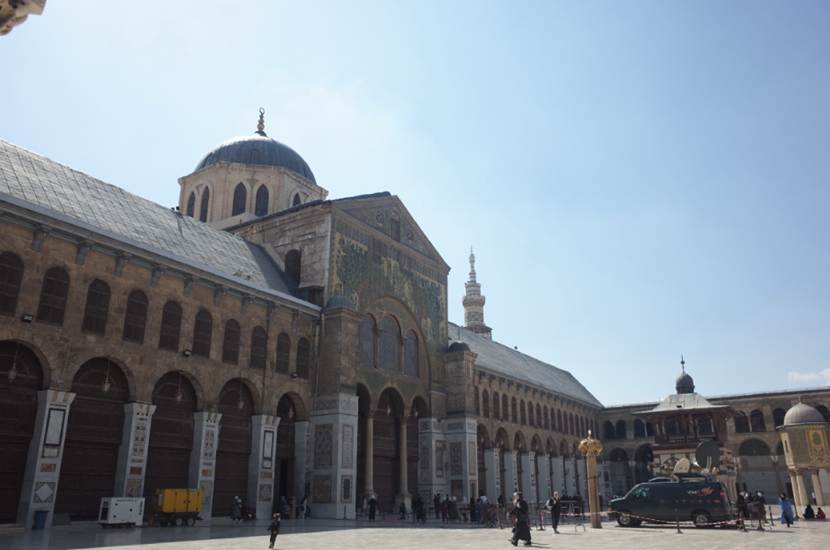
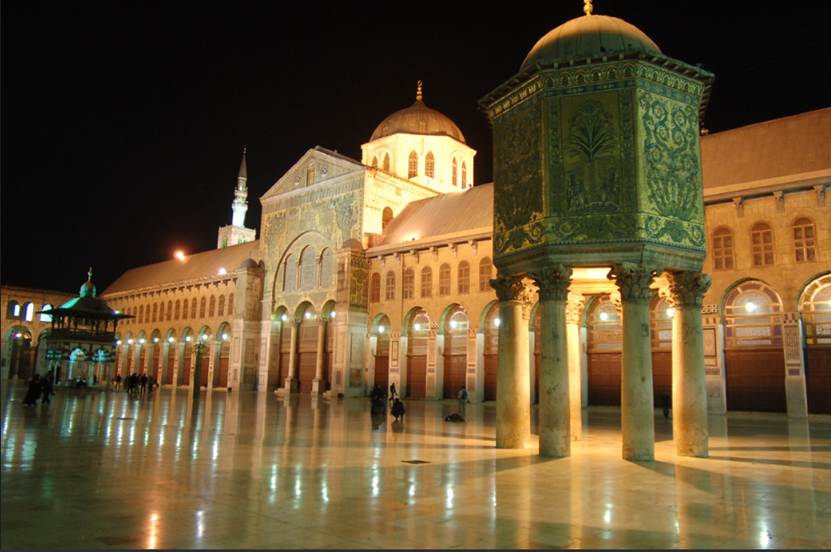
The Umayyad Mosque is located in the heart of the Old City of Damascus. It was built by Caliph Al-Walid ibn Abd al-Malik in a rectangular shape measuring 158×97 meters, in the year 705 CE, on a site where sacred buildings had stood for many years.
The mosque's design relies on the triad of the prayer hall (haram), the courtyard (sahn), and the arcade (riwaq), which responded to the climatic conditions of the region and accommodated all the mosque's diverse functions of worship, learning, arbitration, assembly, and consultation.
The prayer hall (haram): The prayer hall occupies the entire southern side and consists of three arcades equal in width and height, parallel to the direction of the qibla, separated by two rows of Corinthian columns, each row containing eleven arches. The three arcades are roofed with gabled roofs extending from east to west, intersected in the middle of the prayer hall by a transverse aisle running in the north–south direction, distinguished by its architectural and structural independence, its height above the roof of the prayer hall, and the presence of the high dome (the Dome of the Eagle) at its center, resting on an octagonal drum. The mihrab is positioned in the middle of its qibla wall, with its triangular-gabled façade—a new architectural idea intended to emphasize the axis of the Islamic qibla and its difference from the Christian design of churches. The walls of the mosque are covered with panels, ornaments, and inscriptions, the most important of which are the colored glass mosaics that once covered the upper half of the walls, the piers, and the undersides of the arches and vaults, to a height of approximately seven meters.
The courtyard (sahn): The courtyard occupies the northern side of the mosque and is surrounded by roofed arcades on its eastern, northern, and western sides. The arcades are fronted by piers alternating with columns in the western and eastern arcades, with two columns placed between every two piers, and above the arches are openings in the same pattern as those of the prayer hall. The courtyard contains three domes: the Dome of the Treasury, the Dome of Ablution, and the Dome of the Clocks.
The minarets: The mosque has three minarets, the oldest being the northern minaret (the Minaret of the Bride), whose square shape was devised by Al-Walid. He erected it in the middle of the northern wall of the courtyard to emphasize the newly established northern axis, and placed it exactly toward the qibla. It soon became a model adopted for long periods in most mosques of the Islamic world, and its influence extended to include some church towers in southern Europe. In addition, Al-Walid kept the south-western temple tower as it was and rebuilt the south-eastern tower so that both could be used for the call to prayer, before the eastern minaret (the Minaret of Jesus) and the western minaret (the Minaret of Qaytbay) were built upon them.
The entrances: The mosque has four entrances on its four sides. The eastern gate (Jayrun) and the western gate of the mosque are ancient, while the northern one did not exist. However, to emphasize the importance of the axis of the transverse aisle in the prayer hall, the northern wall was pierced at its intersection with the extension of the axis, and a wide, high gate was erected, with the northern minaret beside it. While these three gates open onto the courtyard, the southern gate opens directly onto the prayer hall.
The mosque was subjected to fire, and parts of it burned three times: the first in 1069 CE, which affected the prayer hall; the second at the hands of Tamerlane in 1400 CE; and the third in 1893 CE, which led to the collapse of the roof and columns of the eastern section of the prayer hall. In addition, the earthquakes that struck Damascus caused damage to the mosque: the first in 749 CE led to the cracking of the mosque's roof; the second in 848 CE brought down Al-Walid's minaret; the third in 1157 CE brought down much of the mosque's mosaic; the fourth in 1201 CE brought down parts of the eastern and northern minarets, and the central dome was destroyed; the fifth in 1202 CE brought down the minarets and some of the merlons; the sixth in 1302 CE led to the cracking of the mosque's walls; and the seventh in 1758 CE brought down the central dome, the minarets, and the northern arcade.
The mosque has been restored and repaired at various times in the modern era, starting from the year 1900 CE, the most recent being in 1994 CE.