Kuwait
 Qatar
Qatar
 Saudi Arabia
 Palestine
Palestine
Palestine
 Oman
Oman
 Syria
Syria
 Tunisia
Palestine
Tunisia
Palestine
 United Arab Emirates
 Yemen
Yemen
 Libya
Saudi Arabia
Libya
Saudi Arabia
 Morocco
 Algeria
 Egypt
Egypt
 Iraq
Iraq
 Mauritania
Qatar
Oman
Oman
Oman
Mauritania
Qatar
Oman
Oman
Oman
 Jordan
Qatar
Iraq
Jordan
Qatar
Iraq
 Lebanon
Saudi Arabia
Saudi Arabia
Saudi Arabia
Lebanon
Saudi Arabia
Saudi Arabia
Saudi Arabia
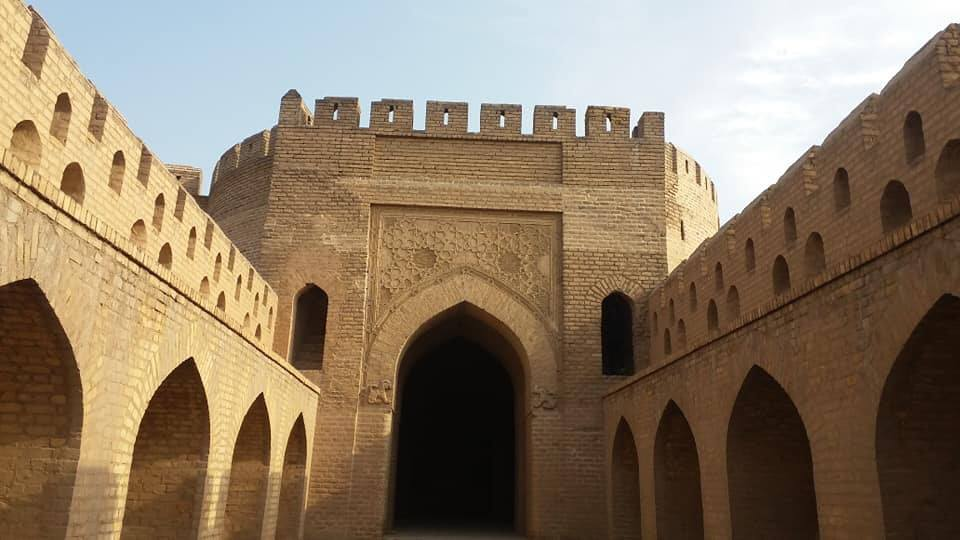
The Middle Gate (Bab al-Wastani) is a fortified citadel that was hard for invaders to breach; it was known as the Khorasan Gate and the Zafariya Gate. It is the only surviving gate of the gates of Baghdad on the eastern side. Important military fortifications were added to it to protect it from any threats or dangers that might approach it.
The gate consists of a large, tall, almost cylindrical tower, built entirely of brick with a distinctive architecture that demonstrates the skill and mastery of the Baghdadi builder. The gate is about three metres wide, topped by a pointed arch with an obtuse angle, and is four metres high. The pointed arch rises above two piers embedded in the wall, and on each side of the arch there is a small lion carved from pieces of brick in relief, along with interlocking geometric shapes in relief formed of two bands, each divided into two parts that intersect to form a regular hexagon. It contains geometric and floral decorative elements, including plant branches and stems with leaves in the shape of half palm-fans, trilobed, forming the Arabic arabesque foliage motifs known as arabesque, composed of geometric shapes and interlacing, intersecting lines. Inside each of the regular geometric shapes there is a rosette flower, forming star patterns with twelve points and small stars with four points enclosing eight-pointed stars within them; in addition, there are fine decorations inside the stars and geometric shapes.
The Middle Gate is distinguished by its solidity and the beauty of its Arab-Islamic decorations. Many of those who invaded Baghdad tried to enter through it but did not succeed, among them Hulagu, who besieged Baghdad and tried to storm this gate several times without success. The last of them was the Iranian Shah Nader Shah, who stood powerless to breach this gate-fortress. Many historians believe that the design and location of this gate made it the most fortified and defensible of Baghdad's gates, as it represents a development of the idea of the domed cylindrical tower, whose dome is reached by stairs from which one overlooks the adjacent space, except that the architect added to it by making its inner entrance perpendicular at a right angle to the outer entrance. The designer of this gate observed the style of the rounded entrances known to the “Round City of Baghdad” and increased its fortification by providing the gate from the inside with a high, open arched bridge, and also surrounded it with a tower and a wide expanse of water, which further increased this fortification, since the wall could only be reached after crossing two successive bridges, where the wall is encircled by a water moat six metres wide.
Fearing the disappearance of this only surviving gate of Baghdad's wall, the Iraqi Ministry of Tourism, in 1988, maintained and restored it and then turned it into a museum of ancient weapons. This museum contained many examples of ancient weapons, most notably cannons, the catapult, and old bombs, as well as various weapons and swords dating back to the first and second Abbasid eras and up to the Ottoman period in Iraq. The oldest Iraqi cannon currently stands in the middle of the gate; it is inscribed as having been made in the year 1806 AD and is 223 cm long, with a muzzle diameter of 22 cm, mounted on a sturdy wooden wheel, and engraved with an image of the crescent as a reference to the emblem of the Ottoman Empire.