Kuwait
 Qatar
Qatar
 Saudi Arabia
 Palestine
Palestine
Palestine
 Oman
Oman
 Syria
Syria
 Tunisia
Palestine
Tunisia
Palestine
 United Arab Emirates
 Yemen
Yemen
 Libya
Saudi Arabia
Libya
Saudi Arabia
 Morocco
 Algeria
 Egypt
Egypt
 Iraq
Iraq
 Mauritania
Qatar
Oman
Oman
Oman
Mauritania
Qatar
Oman
Oman
Oman
 Jordan
Qatar
Iraq
Jordan
Qatar
Iraq
 Lebanon
Saudi Arabia
Saudi Arabia
Saudi Arabia
Lebanon
Saudi Arabia
Saudi Arabia
Saudi Arabia
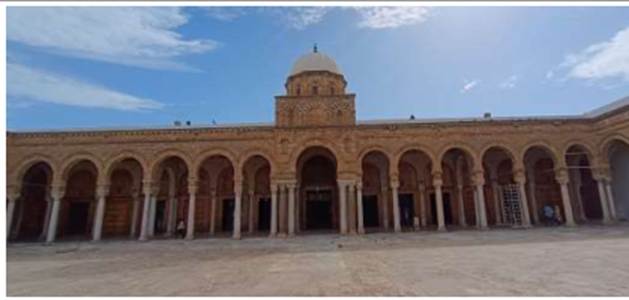
Al-Zaytuna Mosque, also known as the Great Mosque, is the main mosque in the old city of Tunis. Its construction began in 698 CE (79 AH) by order of Hassan ibn al-Nu'man and was completed by Ubayd Allah ibn al-Habhab in 732 CE. It is considered the second oldest mosque in Tunisia after the Mosque of Uqba ibn Nafi. The mosque extends over an area of 5,000 square meters and has nine doors, and its interior hall consists of 184 columns, which were brought from the archaeological site of Carthage.
Since its establishment, the mosque has undergone restorations and alterations carried out by the princes of the ruling dynasties that succeeded one another in Tunisia. The first attempt to develop the mosque architecturally and structurally was made by the Aghlabid prince Abu Ibrahim Ahmad, the great builder who was renowned for his diligence in the country's architecture in the third century AH (the ninth century CE); the mosque's area was expanded and some ornamentation was added to it to such an extent that it appeared in a new form, as if rebuilt. The mosque underwent numerous restorations during the Fatimid era (296 AH – 362 AH / 909 CE – 973 CE) at the hands of the princes of the Zirid (Sanhaja) state, as embodied in the construction of the exquisite dome above the hall and the arcade located in front of the prayer façade.
During the Hafsid era, three halls were established at Al-Zaytuna Mosque for preserving books, and endowments were dedicated to these libraries to meet their needs. Care for the mosques continued during the Ottoman era, especially after the violations inflicted upon it by the Spanish armies, which detracted from its sanctity and prestige. During the Muradid era, Prince Muhammad Bey al-Muradi increased the height of the minaret (sawma'a) and placed a marble sundial in its courtyard to determine the onset of prayer times, and inscribed his name upon it. The custom of the imams and other notable custodians of the mosque contributing to its construction continued during the Husainid era; the Husainid beys and princes gave great attention to the major religious monuments, including Al-Zaytuna Mosque, which received considerable attention, as the old minaret was replaced by an ornate and exquisite minaret built under the supervision of the Endowments Association in the late nineteenth century (1312 AH / 1894 CE). The form of this new minaret was adapted from the Moroccan-Andalusian style.
Al-Zaytuna Mosque also received exceptional care under the post-independence government, as the National Heritage Institute was entrusted with the scientific supervision of the restoration and improvement works, during which decayed column capitals were replaced, some ceilings were renewed, and the original ornamentation inside the two domes was highlighted.