Kuwait
 Qatar
Qatar
 Saudi Arabia
 Palestine
Palestine
Palestine
 Oman
Oman
 Syria
Syria
 Tunisia
Palestine
Tunisia
Palestine
 United Arab Emirates
 Yemen
Yemen
 Libya
Saudi Arabia
Libya
Saudi Arabia
 Morocco
 Algeria
 Egypt
Egypt
 Iraq
Iraq
 Mauritania
Qatar
Oman
Oman
Oman
Mauritania
Qatar
Oman
Oman
Oman
 Jordan
Qatar
Iraq
Jordan
Qatar
Iraq
 Lebanon
Saudi Arabia
Saudi Arabia
Saudi Arabia
Lebanon
Saudi Arabia
Saudi Arabia
Saudi Arabia
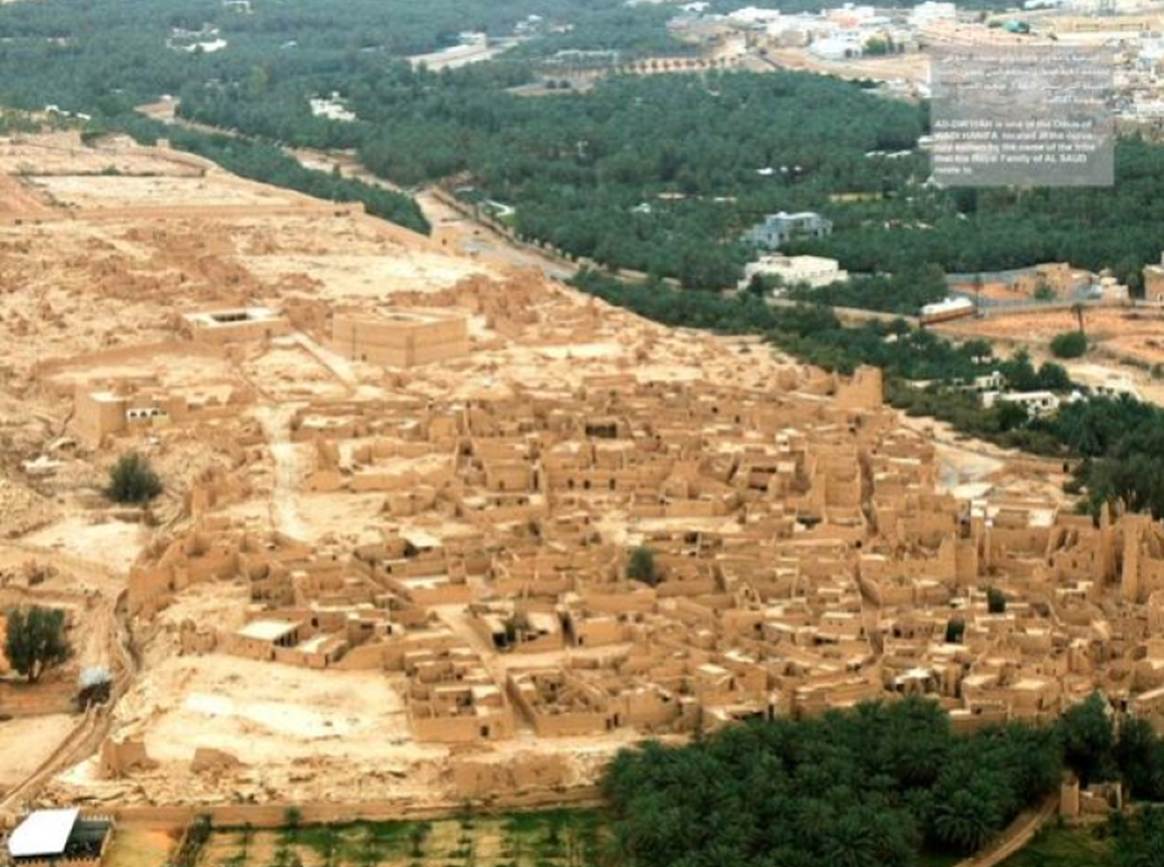
Diriyah represents a turning point in the history of the Arabian Peninsula in particular and in Arab and Islamic history in general, as it laid the foundations for stability and prosperity and united most of the region in the Arabian Peninsula under a single state. Diriyah, at the heart of the Arabian Peninsula, became a destination for trade, culture, knowledge, communication, and economic exchange.
Diriyah was a hub for the trade and pilgrimage routes heading to various parts of the region and a vital link between Asia, Europe, and Africa. Despite the harsh desert environment, Diriyah became an oasis for the model society. This peace and prosperity, and a vision of a state grounded in lofty principles and constants, granted it a prominent political, economic, military, and religious standing in the region, until, over time, it turned into a beacon of science and education.
Diriyah includes many heritage neighbourhoods, the most prominent of which are (Al-Turaif, Ghusaiba, Samhan, Al-Bujairi, Al-Bulaida, and Al-Awda), among other historical neighbourhoods. The Al-Turaif neighbourhood is considered the most prominent of Diriyah's historical neighbourhoods and its most important landmark, as it embraces the most important heritage buildings, palaces, and historical landmarks, comprising most of the administrative buildings in the era of the First Saudi State, such as Salwa Palace, which was established in the late twelfth century AH and from which the affairs of the First Saudi State were run, as well as the Imam Muhammad bin Saud Mosque, Saad bin Saud Palace, Nasser bin Saud Palace, and the traditional Guest Palace, which contains the Turaif bath. The Al-Turaif neighbourhood is surrounded by a large wall and towers that were used for surveillance and defence of the city.
The site of the Al-Turaif neighbourhood in Historical Diriyah was inscribed on UNESCO's World Heritage List on Saturday 19/8/1431 AH, corresponding to 31/7/2010 AD, after the completion of a large set of steps and projects that qualified the site for its inscription on the World Heritage List.