Kuwait
 Qatar
Qatar
 Saudi Arabia
 Palestine
Palestine
Palestine
 Oman
Oman
 Syria
Syria
 Tunisia
Palestine
Tunisia
Palestine
 United Arab Emirates
 Yemen
Yemen
 Libya
Saudi Arabia
Libya
Saudi Arabia
 Morocco
 Algeria
 Egypt
Egypt
 Iraq
Iraq
 Mauritania
Qatar
Oman
Oman
Oman
Mauritania
Qatar
Oman
Oman
Oman
 Jordan
Qatar
Iraq
Jordan
Qatar
Iraq
 Lebanon
Saudi Arabia
Saudi Arabia
Saudi Arabia
Lebanon
Saudi Arabia
Saudi Arabia
Saudi Arabia
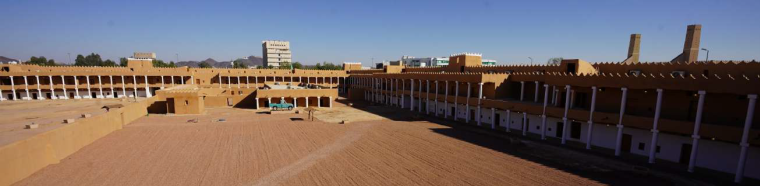
Al-Qishla Fort is located in the city of Ha'il in the Kingdom of Saudi Arabia. It was built by order of King Abdulaziz bin Abdulrahman Al Saud in the year 1360 AH / 1941 AD, to serve as a military barracks belonging to the Saudi army in the Ha'il region.
The fort is considered one of the largest mud-brick buildings, as its area amounts to approximately 20,000 square metres. It is built in the shape of a regular rectangle, and it includes a spacious inner courtyard surrounded by arcades and rooms on all four sides. Distributed at the corners of the fort are four circular defensive towers, in addition to four additional towers in the middle of each side, and they are equipped with firing loopholes (embrasures) that reflect the military function of the building. The walls are topped by crenellated battlements for surveillance and protection, which shows the extent of the robust defensive planning of the fort.
The fort was built using traditional Najdi building techniques, whereby the walls were built of sun-dried mud bricks reinforced with tamarisk trunks, and roofed using palm wood covered with layers of treated mud, which gives the building suitable thermal insulation for the region's climate. As for the facades of the fort, especially the eastern one, they feature distinctive plaster decorations with geometric and star-shaped motifs representing the local artistic heritage.
The fort played an important role in establishing security and order during the founding period, and it was used to house soldiers and manage military operations, as it contained administrative, residential and training units, and was later used as a headquarters for the police until the year 1395 AH, then its administration was transferred to the Antiquities and Museums Agency with the aim of transforming it into a cultural and heritage centre serving the region.
Today the fort represents a symbol of the urban heritage in the city of Ha'il, and a living example of the ability of traditional Najdi architecture to adapt to different functions and the local climate. It still retains its original identity in an exceptional way, which makes it one of the most prominent urban landmarks worthy of documentation and preservation.